


- The Japanese Writing System
The 3 Types of Characters
 Niko
There are three types of Japanese characters: (1) Hiragana, (2) Katakana, and (3) Kanji.
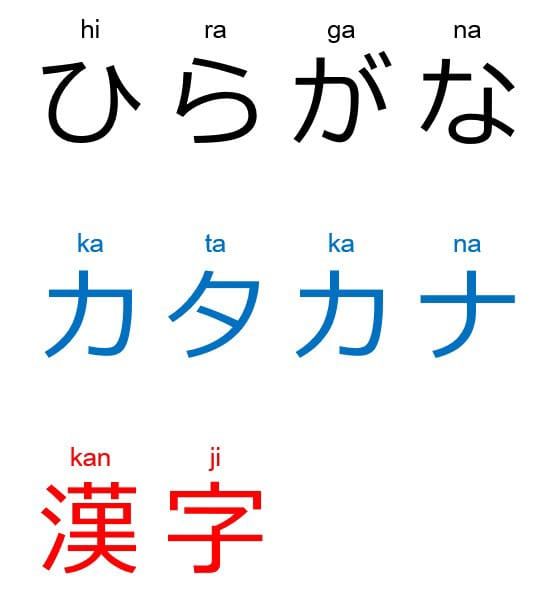
First, here’s the short version: Hiragana and Katakana represent the sounds of Japanese, with katakana being used primarily for foreign loan words and hiragana being used for everything else. Kanji, on the other hand, are (logographic) characters adopted from China.
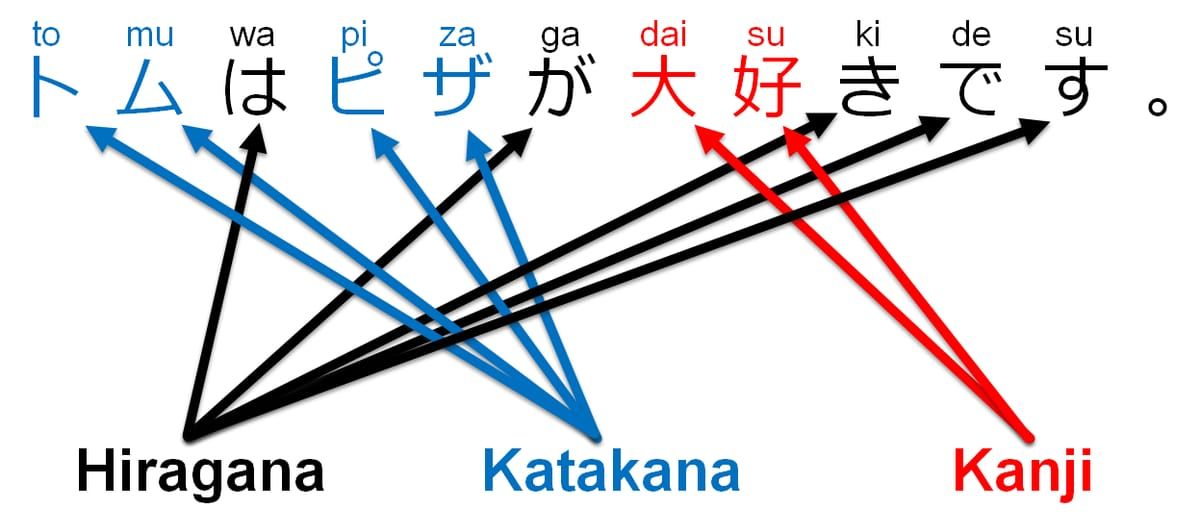
Put once more in overly simplified terms, hiragana and katakana represent sounds, whereas kanji represent meanings, and all three of them (can) represent words or parts of words:
"Tom loves pizza."
Kana & Pronunciation Course
Kana & Pronunciation Course
Kana & Pronunciation Course
Let’s take a quick look at why we use the three different types of characters in this sentence, which, by the way, means “Tom loves pizza.”
In this example, トム (tomu) “Tom” and ピザ (piza) “pizza” are written in katakana, because Tom is a foreign name and ピザ (piza) is a foreign loan word.
Note: Katakana is not limited to foreign names and loan words. For example, manga (a Japanese type of comic book) is sometimes written in kanji, as 漫画, and sometimes written in katakana, as マンガ. Also, sometimes katakana will be used to give a word a rough nuance and/or make it seem emphasized in some way.
Kanji is used for the first two of three characters in the word ⼤好き (daisuki), which means “liking very much” or “loving.” The character ⼤ means “big” and the character 好 means “favorable” or “pleasing.” So “big pleasing” means “liking a lot” or “loving.” Although it is not 100% apparent from a simple example like this, once you know the meanings of the kanji, having them in sentences makes them (1) easier to read, because they break up what would otherwise be long strings of hiragana, and (2) easier to understand, because there are little “clues” to the meanings of each word in each kanji.
Hiragana is used for everything else in the sentence. It is used for the particles は (wa [irregular reading]) and が (ga), for です (desu), which is kind of like the verb “to be,” and for the final ki sound in ⼤好き (daisuki), which has no kanji.
Uh, wait a sec. Particles? Kind-of verbs? Yeah, sorry. You can learn about those when you get to our Bunkai Beast course or other grammar-related materials out there in the world. Let's not worry about it just yet.
Niko
