


- NDL
You VS a 1st Grader
 Niko
Do you remember taking English tests back when you were in 1st grade? (Or French tests, if you're French; German tests if you're German, etc.)
How did you do?
Think you could pass a 国語のテスト (こくご の テスト // Japanese test) that they give out to 小学一年生 (しょうがく いちねんせい // 1st grade students)?
That reminds me, check out this lesson for info on how to number the years for Japanese schools: The Age You Can Eat Anything.
Also, we just saw how 国語, "country language," means "Japanese" back in Who cares!
Oh yeah, back to school.
Here's your test:
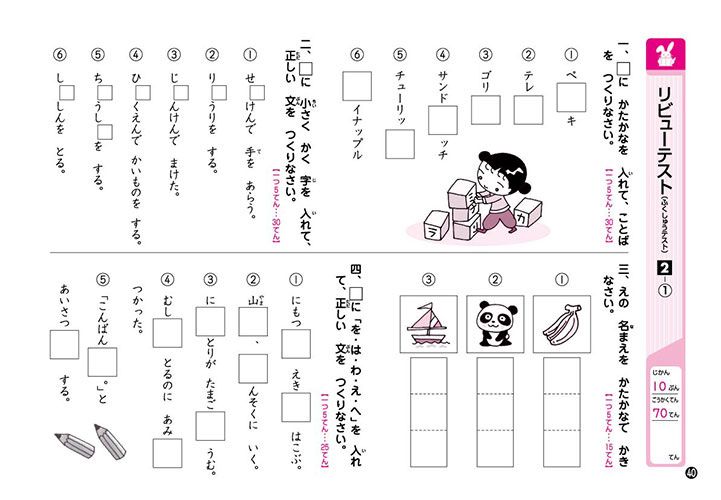
Sorry if that's a little hard to read, even when it's full-sized. But reading slightlyblurry kana is also a skill that we must master, sadly.
What are you reading this for? Go take that test!
Oh, it might help if I write the instructions, huh?
(Note: I'm writing the instructions how an adult would write them, because this hiragana-only stuff is going to make us stupid.)
(Note #2: Notice how all of these instructions use the command form of adding ~なさい to the masu-stem of verbs. They teach this fairly early in Japanese classes (maybe JLPT N5?), because you see it in children's books and stuff, I guess. You won't get many chances to use this one, though... unless you have kids, I guess. Don't use it with your friends, because no one likes getting bossed around.)
Top-Right Instructions:
一、☐にカタカナを入れて、言葉を作りなさい。
いち、 しかく に かたかな を いれて、 ことば を つくりなさい。
First, make words by writing katakana in the blank spaces.
Top-Left Instructions:
二、☐に小さく書く字を入れて、正しい文を作りなさい。
に、 しかく に ちいさく かく じ を いれて、 ただしい ぶん を つくりなさい。
Second, make correct sentences by writing small characters in the squares.
Bottom-Right Instructions:
三、絵の名前をカタカナで書きなさい。
さん、 え の なまえ を かたかな で かきなさい。
Three, write the name of the pictures in katakana.
Bottom-Left Instructions:
四、☐に「を・は・わ・え・へ」を入れて、正しい文を作りなさい。
よん、 しかく に「を・は・わ・え・へ」を いれて、 ただしい ぶん を つくりなさい。
Four, make correct sentences by inserting "を, は, わ, へ, or え" in the squares.
I'll write the answers below...
✍ Answers to the test (↑) are below (↓). 📜
✍ Answers to the test (↑) are below (↓). 📜
✍ Answers to the test (↑) are below (↓). 📜
✍ Answers to the test (↑) are below (↓). 📜
✍ Answers to the test (↑) are below (↓). 📜
✍ Answers to the test (↑) are below (↓). 📜
✍ Answers to the test (↑) are below (↓). 📜
✍ Answers to the test (↑) are below (↓). 📜
✍ Answers to the test (↑) are below (↓). 📜
✍ Answers to the test (↑) are below (↓). 📜
So don't scroll any farther until you test yourself!
✍ Answers to the test (↑) are below (↓). 📜
✍ Answers to the test (↑) are below (↓). 📜
✍ Answers to the test (↑) are below (↓). 📜
✍ Answers to the test (↑) are below (↓). 📜
✍ Answers to the test (↑) are below (↓). 📜
✍ Answers to the test (↑) are below (↓). 📜
✍ Answers to the test (↑) are below (↓). 📜
✍ Answers to the test (↑) are below (↓). 📜
✍ Answers to the test (↑) are below (↓). 📜
✍ Answers to the test (↑) are below (↓). 📜
OK. Answer time.
Answers to the top-right section.
① ペンキ
② テレビ
③ ゴリラ
④ サンドイッチ
➄ チューリップ
➅ パイナップル
Here are the answers with translations:
① ペンキ(paint)
② テレビ(TV)
③ ゴリラ(gorilla)
④ サンドイッチ(sandwich)
➄ チューリップ(tulip)
➅ パイナップル(pineapple)
Answers to the top-left section.
① せっけんで てを あらう。
② りょうりを する。
③ じゃんけんで まけた。
④ ひゃくえんで かいものを する。
➄ ちゅうしゃを する。
➅ しゃしんを とる。
Here are the answers with kanji and translations:
(Translation Note: I almost translated these simplistic sentences into dictionary-like phrases. For example, "to wash one's hands with soap." Instead, I made full sentences such as "I wash my hands with soap." They can sound a little bit weird. But then, so does the English. Typical 1st-grader mumbo jumbo.)
①
石鹸で手を洗う。
せっけん で て を あらう。
I wash my hands with soap.
②
料理をする。
りょうり を する。
I cook.
③
じゃんけんで負けた。
じゃんけん で まけた。
I lost at rock-paper-scissors.
④
100円で買い物をする。
ひゃく えん で かいもの を する。
I go shopping with 100 yen.
➄
注射をする。
ちゅうしゃ を する。
He gives an injection.
➅
写真を撮る。
しゃしん を とる。
I take a picture.
Answers to the bottom-right section.
① バナナ
② パンダ
③ ヨット
With translations, that's...
① バナナ(banana)
② パンダ(panda)
③ ヨット(yacht)
And, finally...
Answers to the bottom-left section.
① にもつを えき へはこぶ。
② やまへ、えんそくに いく。
③ にわとりが たまごを うむ。
④ むしを とるのに あみを つかった。
➄ 「こんばんは。」と あいさつを する。
Hold on! I got #1 wrong! WTF.
Apparently I forgot to read the instructions. Whatever, dude. I maintain that に would have been fine there, as well.
Moving on, here are the answers with kanji and translations:
①
荷物を駅へ運ぶ。
にもつ を えき へ はこぶ。
I carry bags to the station.
②
山へ、遠足に行く。
やま へ、 えんそく に いく。
We go on a field trip the mountains.
I always thought 見学 (けんがく) was the word for "field trip." But a 見学 does not have to be through a school, so it's not really a field trip... it just means something like "visit" or "observe." The educational, school version of a "field trip" is called 社会科見学 (しゃかいかけんがく). 遠足 is "cool field trips," like going to the mountains.
③
にわとりが卵を産む。
にわとり が たまご を うむ。
The chicken lays an egg.
Back in the day, I said that I ate にわとり once, and everyone laughed at me. A にわとり is the actual bird, but the meat of a chicken usually uses the katakana word チキン.
④
虫をとるのにあみを使った。
むし を とる のに あみ を つかった。
I used a net to catch bugs.
➄
「こんばんは。」と挨拶をする。
「こんばんは。」と あいさつ を する。
I greet by saying, "Good evening."
Did you fail?
If so, I have good news for you: No one will hate you for failing a first-grader's test in Japanese.
So get up, dust yourself off, and go challenge yourself to a lot more tests for kids.
Oh, and that original test came from this site. Maybe buy one of their books or something? I mean, if you like tests for elementary school students.
Niko

