


- NDL
Rolling Up Our Sleeves and... Acting with Reckless Abandon?
 Niko
Word of the day:
捲る
まくる
to turn up; to roll up (e.g. sleeves)
For example, if someone is stirring a giant soup in the kitchen, and you think they're gonna get their sleeves covered in soup, then you could say:
そで捲ったほうがいいよ。
そで まくった ほう が いい よ。
You should roll up your sleeves.
The English says "roll up," but the nuance of 捲る isn't really "roll (tightly)," as that would be 巻く (まく), but rather "turn up."
捲る/巻く
まくる/まく
to turn up/to wind; to roll; to coil
We see this 巻く in the word 巻き寿司 (まきずし // rolled sushi). We just call them rolls:
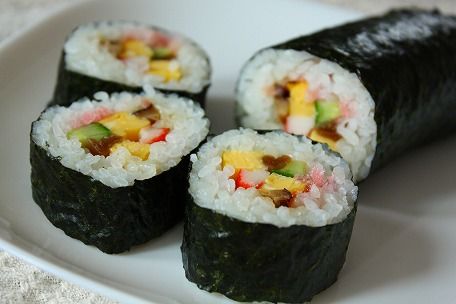
Let's not confuse that with "rolling up" our sleeves, which uses 捲る (まくる):

Or maybe I should say, "Let's pretend we're not confused." Because I think I am. Confused, that is.
And since we're already confused, here's an example that I would have translated wrong without Rei's help:
布団を捲ったら猫がいた。
ふとん を まくったら ねこ が いた。
When I pulled back the comforter, the cat was in it!
This is grossly confusing, but this "futon" is actually referring to 掛け布団 (かけぶとん), a "comforter" or "bed cover." It's not referring to the 布団 (ふとん) that you sleep on top of, which is a Japanese-style mattress laid on the floor. I almost wrote "turned down" instead of "pulled back," but that sounded a little too formal to me.
So, not the bottom part of this image; rather; the fluffy comforter in the middle:

On a strange side note, the word 捲る (めくる), which I often just see written in hiragana, means to "turn over," and it's used for "turning" the pages of a book:
ページをめくる
ページ を めくる
to turn a page

Once again, that's めくる, not まくる.
Anyways, all that confusing stuff aside, today's lesson looks at what happens when we put ~まくる onto the end of the masu-stem of a verb:
VERB's masu-stem + ~まくる
=
VERB like crazy; VERB with reckless abandon
I have no idea why it means that, but it does. Examples below.
VERB:
働く(はたらく // to work)
後悔する(こうかいする // to regret)
飲む(のむ // to drink)
見る(みる // to watch; to see)
走る(はしる // to run)
嘘をつく(うそをつく // to tell a lie)
吐く(はく // to throw up; to spit)
Masu-Stems:
働き~(はたらき)
後悔し~(こうかいし)
飲み~(のみ)
見~(み)
走り~(はしり)
嘘をつき~(うそをつき)
吐き~(はき)
VERB-ing Like Crazy:
働きまくる(はたらきまくる // work like crazy)
後悔しまくる(こうかいしまくる // regret like crazy)
飲みまくる(のみまくる // drink like crazy)
見まくる(みまくる // watch like crazy)
走りまくる(はしりまくる // run like crazy)
嘘をつきまくる(うそをつきまくる // lie like crazy)
吐きまくる(はきまくる // throw up like crazy)
Got the structure down?
If so, let's look at some full sentences!
今年は働きまくりの1年だった。
ことし は はたらきまくり の いちねん だった。
I was working like crazy all year this year.
顔にタトゥー入れたこと、後悔しまくり。
かお に タトゥー いれた こと、 こうかい しまくり。
I really, really regret getting a tattoo on my face.
Speaking of tattoos, Japanese people are pretty closed-minded about them. Some of my friends that have tattoos have had to deal with some fairly annoying treatment. I can't speak from experience, though, as I don't have them myself. Mostly because (1) I'm afraid of my mom and (2) I change my mind way too often to even get close to picking a good one.
「ビール飲みまくりダイエット」とか無いかなー。
「ビール のみまくり ダイエット」 とか ない かなー。
I wonder if there's a "drink like crazy" diet or something (because that'd be great).
週末は家でドラマ見まくるつもり。
しゅうまつ は いえ で ドラマ みまくる つもり。
This weekend I'm planning to binge-watch dramas at home.
毎日走りまくって10キロ痩せた!
まいにち はしりまくって じゅっ キロ やせた!
I ran like a mad person every day, and I lost ten kilos!
嘘をつきまくったせいで友達がいなくなった。
うそ を つきまくった せい で ともだち が いなく なった。
I kept lying so much that I lost all of my friends.
A:
今何してる?
いま なに してる?
What are you up to?
B:
二日酔いで吐きまくってる。
ふつかよい で はきまくってる。
Puking my brains out because I'm so hungover.
That's all for today. Hope you're studying like crazy!
Niko
