


- Kanji-Learning Methods
The Organic Method
 Niko
The mnemonic method of learning kanji is optional. If it doesn't appeal to you, then it is not required that you use it.
The organic method, however, is followed by anyone who learns to read Japanese at a high level, even people that do not realize they have been using it.
The basic premise is this: After seeing a word written in Japanese enough times, your brain starts to recognize it.
We talked about how writing the same kanji over and over again is not a very effective way to learn it, right?
集集集集集集集集集集集集集集集集 Gather. Gather. Gather. Gather. Gather. Gather. Gather. Gather. Gather. Gather. Gather. Gather. Gather. Gather. Gather. Gather.
This is not to say that seeing a kanji written over and over again is not helpful. The key is to see it written in an actual word.
Take the word 募集 (ぼしゅう), for example, which means something like "recruiting; taking applications." This makes sense, seeing as how the kanji are 募 (recruit) and 集 (gather). It is very common to see this word written in help wanted ads in Japan:
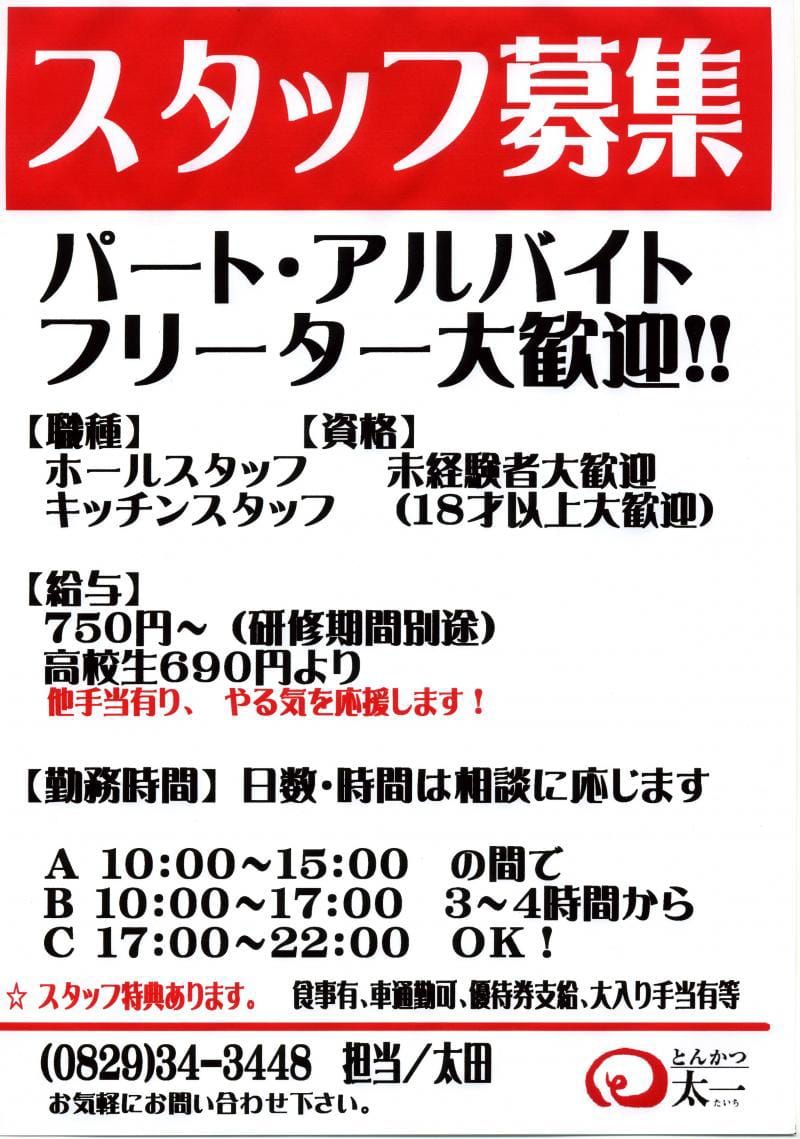
See the very top of the ad? It says スタッフ募集 (スタッフぼしゅう), which literally means "staff recruiting." In other words, the ad is saying "Help Wanted"
If you are looking to hire a lot of people, you can put the kanji for "large" in front of the word, giving us ⼤募集 (だいぼしゅう), which my dictionary somewhat awkwardly translates as "mass recruitment."
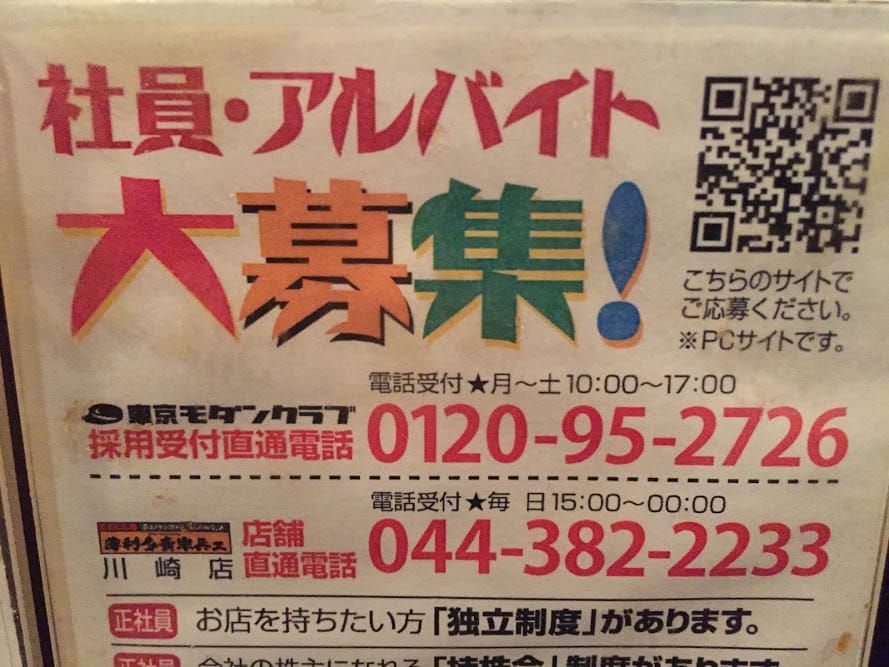
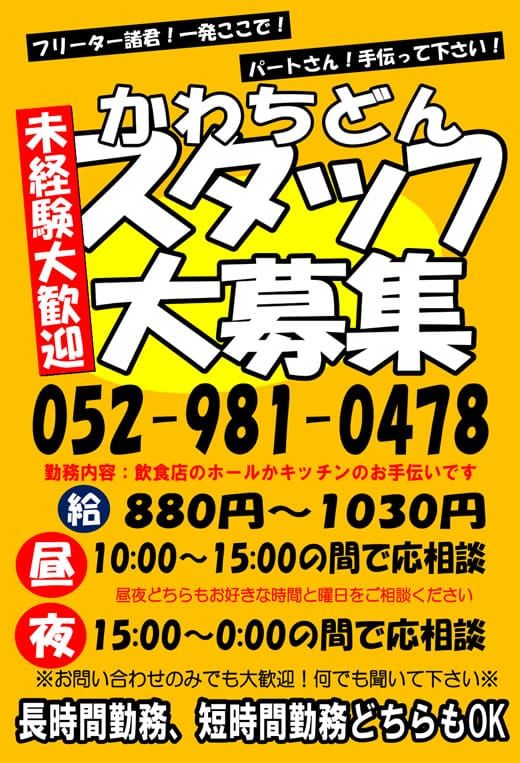
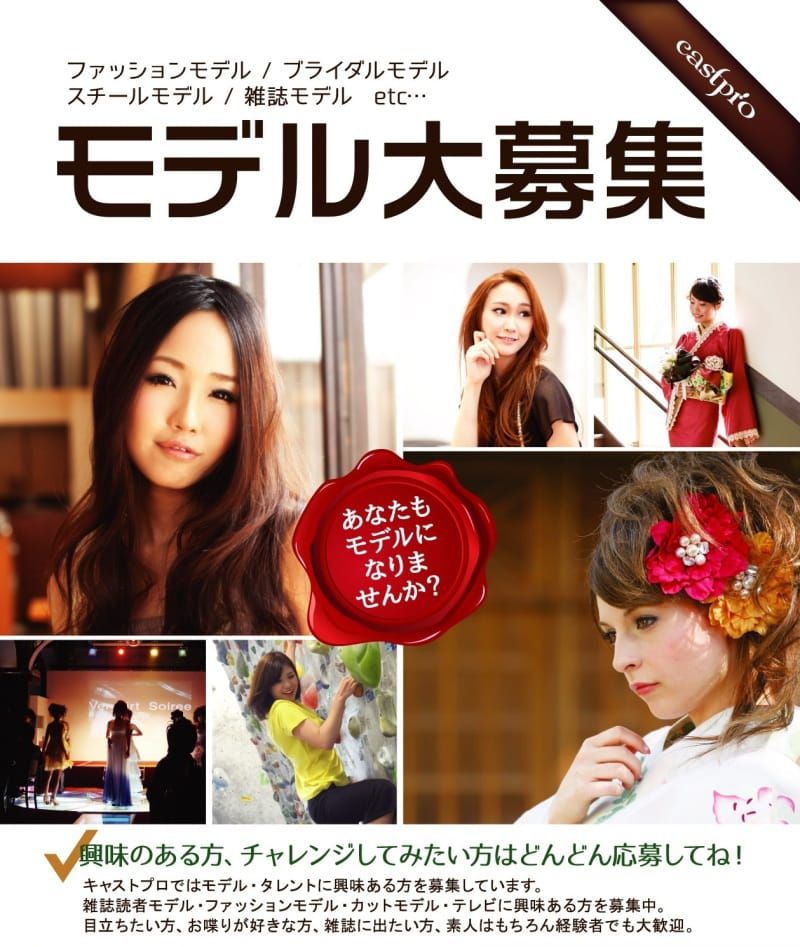
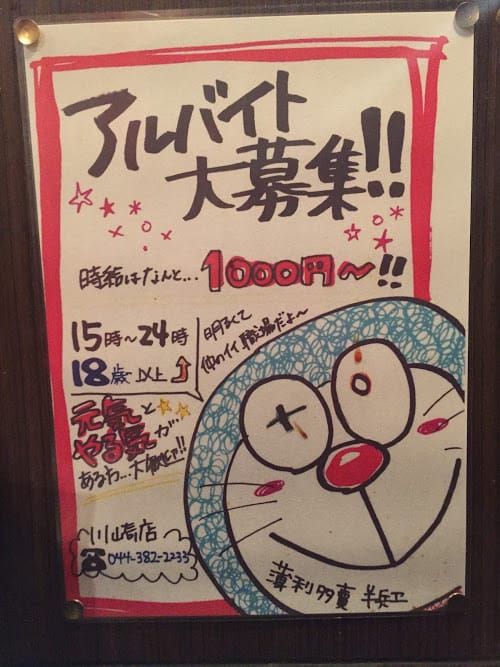
Sometimes you'll see the kanji 中, which means "in" or "inside" at the end of the word: 募集中 (ぼしゅうちゅう). So, this means "in the middle of recruiting" or, in more natural English, "Now Hiring."
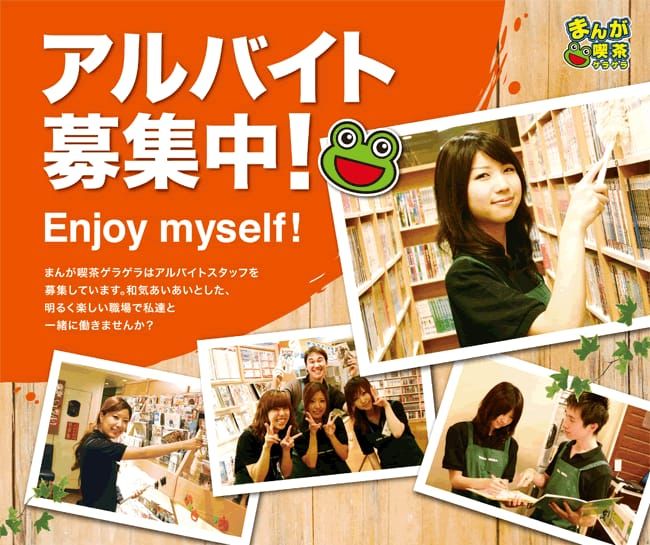
Imagine seeing ads like these almost every day of your life for 10 years, 15 years, 20 years! It would be difficult for you to not recognize the kanji 集.
This is why it seems a bit ridiculous to me when Japanese people say that they learned kanji by writing them. Maybe they learned to write kanji by writing them, but they learned to recognize and read kanji by seeing them written everywhere over and over and over again.
We want to do the same thing.
To phrase it another way, we want to build up a "sight vocabulary" in Japanese.
Sight Vocabulary
Consider, if you will, the following passage:
It deosn't mttaer in waht oredr the ltteers in a wrod are, the olny iprmoetnt tihng is taht soem ltteers be in the rghit pclae. The rset can be a toatl mses and you can sitll raed it wouthit a porbelm. Tihs is bcuseae the huamn mnid deos not raed ervey lteter by istlef, but the wrod as a wlohe.
If you're a native speaker of English, then reading the passage above shouldn't be too hard. The reason is that your brain does not go letter by letter when you read something. It processes entire words — and especially shorter, common words — as complete images. (Linguists and researchers like to argue about the technical mechanics behind this, but for our purposes it's not all that important why or how it happens, just the fact that it does happen.)
To rip off my good friend and mentor, Wikipedia…
Sight words, often also called high frequency sight words, are commonly used words that young children are encouraged to memorize as a whole by sight, so that they can automatically recognize these words in print without having to use any strategies to decode. – “Sight word,” Wikipedia
When a native, adult speaker sees words like these, they don’t read them:
- the
- could
- should
- might
- was
- did
- how
- when
- went
- fast
You’ve seen those words so many times, that the entire word is an image in your mind.
This is different than words like this, which are less common:
- cacophonous
- nonconstructive
- infallibility
- respite
You’re more likely to recognize these words after you have assembled all (or at least some) of the letters in your mind.
If you read them enough times, though, they do become images in your mind. That is, they become part of your sight vocabulary, which is the number of words you recognize instantly by sight.
I would like to humbly suggest that Japanese people are recognizing Japanese words in the exact same way. The main reason I think so is that I no longer have to "think about" the characters in common Japanese words when I'm reading the language. When I encounter common words — words I've seen thousands of times — my brain seems to process them instantaneously.
The ultimate goal, then, is not the "learn" all of the common kanji in Japanese.
Instead, the ultimate goal is to build a Japanese sight vocabulary that includes words containing all or most of the common kanji in Japanese.
As a student of Japanese, it is possible to do this… but it takes a lot of time.
My progress went something like this:
1. Could understand NO kanji
2. Learned to recall kanji using mnemonics (i.e. "learned" all general-use kanji using "the mnemonic method")
3. Learned to instantly recognize a large enough number of Japanese words to "know" most kanji characters (i.e. "learned" all/most general-use kanji using "the organic method")
Step #1 is what it’s like when you’re just starting your Japanese studies.
Step #2 is what it feels like after you’ve finished, for example, the 97-day kanji challenge, which we'll talk about in the next section of the course.
Step #3 is what happens gradually over the course of several years (of high levels of focused, level-appropriate language exposure).
Once you get to Step #3, you know all of these kanji, for example, the very moment you see them:
- 急
- 級
- 球
- 休
You also know that, in some cases, all of these kanji are pronounced きゅう (kyuu). And you know multiple words for each of them.
For example, without consulting a dictionary, I can say that…
- 急 is the きゅう in 急に (きゅう に), “suddenly.” It is the きゅう in 急⾏ (きゅうこう), “express (train).”
- 級 is the きゅう in ⾼級 (こうきゅう), “high-grade.” It is the きゅう in 初級者 (しょきゅうしゃ), “beginner.”
- 球 is the きゅう in 気球 (ききゅう), “hot-air balloon.” It is the きゅう in… uh, I can’t think of a second word off the top of my head! *_*
- 休 is the きゅう in 休憩 (きゅうけい), “a rest; a break.” It is the きゅう in 有給休暇 (ゆうきゅう きゅうか), “paid holiday,” a word I forgot over and over again, because I was able to take such a pitifully small number of paid holidays when working in Japan!
I know what some of you are thinking: It'll take forever to learn all of that for 2,000+ kanji!
Not quite. It happens gradually, so it gets easier over time. And it happens naturally if you
set up your study materials effectively, which is what I want to talk about next.
Note: A student told me that he saw the list of readings/kanji above and that it caused him to lose a lot of motivation…. as a result, I feel that maybe I didn’t explain the cool part about all of this well enough.
When I was learning the kanji, the thought of learning all of these readings was so intimidating to me. I just didn’t believe that I could do it, and seeing a list like this would have caused me to lose motivation, too.
But learning the pronunciation of the kanji is nothing like learning the meaning of the kanji. You don’t have to sit down and follow a schedule for learning one or two words for every single kanji. Rather, you can just interact with this language and pick these up naturally (while still studying, of course).
Most importantly: The more vocab you learn, the easier it gets to learn new vocab. If I tried, I’m pretty confident that I could learn 100 new vocab per day in Japanese (maybe I should try a language challenge ^_^), because I’ve built up a huge foundation of words over time.
Learning these words that I’ve listed above was fun because I learned them while studying fun materials that I enjoy. I learned them while I was drinking with friends in Shibuya. I learned them while listening to hilarious podcasts. While listening to my co-workers complain about their jobs. While listening to Japanese pop songs from the 1960’s. While reading manga and novels. Watching weird anime robots with magic powers.
Learning a language is not about completing checklists and putting books in your head. It’s about… well, I don’t know. Being human? Communicating with awesome people from faraway lands? Learning about different cultures, viewpoints, and experiences? It’s about more things than I can count.
The Organic Method
This is much less difficult to explain than the mnemonic method.
To follow the organic method of kanji learning, all you need to do is use, study, and encounter written Japanese the same way that educated adult speakers of Japanese use it.
Take a look at the following Japanese sentence:
スタッフを募集してます。 スタッフ を ぼしゅう してます。 Now looking for staff. Literally: "staff + を + recruiting / taking applications + are doing."
↑ This is the format that we use when writing 99.999% of the Japanese sentences we teach in NihongoShark lessons.
You've already heard me complain about teachers dumbing down Japanese content to make it easier for us, yeah? For example, it would not surprise me if a Japanese teacher wrote the above sentence as:
スタッフをぼしゅうしてます。
(If we're being realistic, an old-school Japanese teacher would not write してます, either, because it is spoken language. The would use the stiffer-sounding しています. A conversation for another day.)
Writing Japanese without kanji like this is detrimental to the progress of students like you and me. We want to build our Japanese sight vocabulary. But we can't build it if we're not seeing Japanese the way it is supposed to be written! Agh! It drives me crazy!
Taking this a step further, people sometimes ask me why we don't embed kana breakdowns in our sentences or use furigana (=small kana readings written above kanji), like this:
スタッフを募集(ぼしゅう)してます。 Now looking for staff. Literally: "staff + を + recruiting / taking applications + are doing."
ぼ し ゅ う
ぼ し ゅ う スタッフを募集してます。 Now looking for staff. Literally: "staff + を + recruiting / taking applications + are doing."
It's not so terrible if Japanese learning materials write content this way. I think the version with the parentheses is a bit jarring, particularly if you're trying to read longer texts. The version with the furigana is pleasant to read, however. (Sadly, furigana doesn't always show up properly in web browsers.)
Of these three options, however, I would argue that it is best to write the kana in a separate line below the natural version of the sentence, as we do:
スタッフを募集してます。 スタッフ を ぼしゅう してます。 Now looking for staff. Literally: "staff + を + recruiting / taking applications + are doing."
The reason is that we want to attempt to read the Japanese as it is naturally written (i.e. with kanji) every single time we encounter it, even if we do not know the words or kanji in the sentence. We are trying to get as much exposure to the language as it is naturally written as possible. Doing so, we can build up our Japanese sight vocabulary bit by bit.
The awesome thing about studying with flashcards, is that we don't have to worry about any of this stuff. We can just put the kana readings on the back of our flashcards:
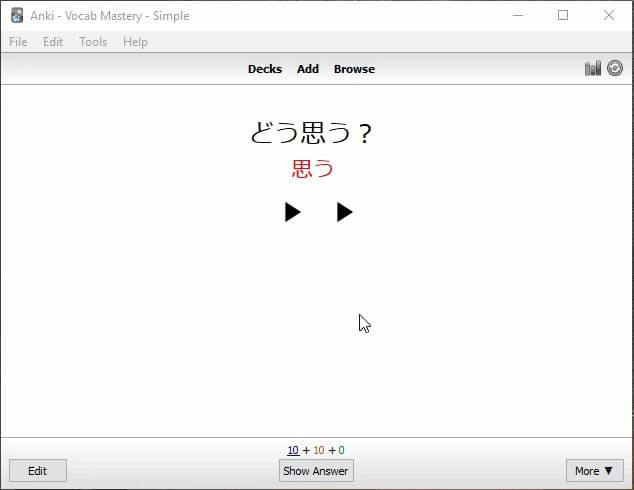
↑ This is the flashcard deck provided in our Vocab Mastery course... which brings me to my next point:
How to study with the organic method: Just don't worry about any of this.
We have set up our vocab flashcards so that they expose you to naturally written Japanese. Our hundreds and hundreds of Japanese lessons also expose you to Japanese as adult native speakers write it. Accordingly, you will be following the organic method and building your Japanese sight vocabulary simply by going through our study materials.
Easy, yeah?
The reason it's easy is that every person who studies Japanese must study kanji via the organic method to some degree. It's a natural part of encountering the language (which is why we call it "organic" and not, say, "artificial"). We just make sure that NihongoShark students utilize the organic method as much as possible. Study materials that expose you to unnatural forms of written Japanese are slowing your progress toward advanced reading comprehension.
OK.
So, some people study with the mnemonic method.
And all people study with the organic method.
How can we combine or not combine these and integrate them into our own studies?
...is the topic of the next lecture...
Niko
