


- Flashcards
Anki Avalanche
 Niko
If you're like the vast majority of us other imperfect humans, then you're probably going to eventually fail to do your flashcards consistently for an extended period of time leading to what we refer to as "Anki Avalanche."

Anki Avalanche: The situation in which you have an impossibly high number of Anki flashcards due for review because you have failed to study your flashcards for too many days.
It sucks when this happens. You feel like you're forgetting everything that you've worked so hard to learn. You feel guilty for failing to study so many days. You feel stressed that you'll never be able to catch up.
But don't worry. We still have some options when this happens. Before exploring them, however, I have a bit of a confession to make: As I write this, I am currently facing a bit of an Anki avalanche.
You may remember that as of a few years ago, I had 20,000-something mature flashcards
in Anki, right? Well, things are a bit different now because I stopped studying Japanese flashcards about a year ago.
S-s-stopped?!
Yeah. The thing is, once you get to a certain level, Anki flashcards aren't all that necessary anymore. If I want to improve at Japanese, I can just read novels in Japanese, or play a video game in Japanese, or chat with friends, family members, etc. (I do still take lessons, though. And I write lots of lessons for this site. So, I can't really escape from improving my Japanese at this point.)
Anyway, Japanese aside, I still have other decks. And though I missed almost zero days of reviewing flashcards from early 2012 to early 2016, I fail to study my flashcards all the time nowadays. What happened?!
"Niko's Daily Lessons (NDL's)" happened. I started writing them at the end of 2015, and I sort of hit my limit on what I could manage in one day. I had two full-time jobs (=managing this site and writing/translating for an editing company in Tokyo), along with a brand new, accurate Japanese lesson to write, edit, and post 7 days per week, all on top of doing Anki flashcards every single morning, trying to exercise, and all of that other stuff people do.
↑ Those are my excuses. The real reason I started failing to do flashcards daily was that other things became a higher priority to me. Thus, it's no surprise that I'm facing an Anki avalanche as we speak:
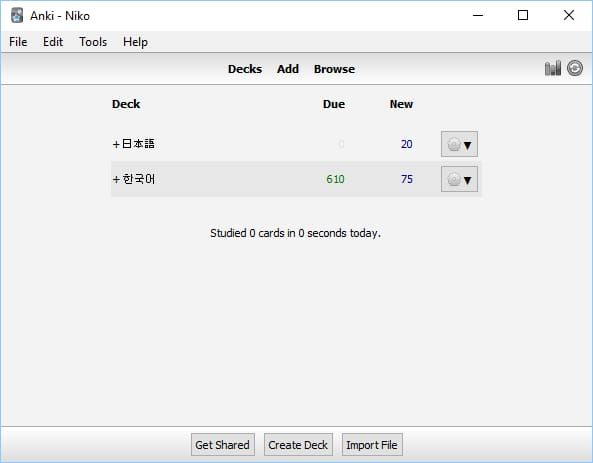
(Note: If you're wondering why I have a Japanese deck, it's because I do still make flashcard decks using Japanese video games, but I set the daily review count to zero and only study new cards. More about making decks like these can be found in the Flashcard Demigod course.)
So, it looks like I have 610 Korean cards due for review today. Some might consider this a minor Anki avalanche. (The worst one I ever had was about 4,000 cards.) Still, it's a bit stressful. Here are my options...
Option #1: Stick it out
I could just rely on grit, study for a few hours, and grind my way through all of those flashcards during the next day or two.
Since there are only 610 of them, this wouldn't be too hard to accomplish.
I'm not going to use this method, though, since I don't have time to be studying that much right now (i.e. my flashcards are not a high enough priority, which is what caused this problem in the first place).
Option #2: Cheat
This is probably what I do most often when faced with an Anki avalanche. I just quickly hit "Good" on every single flashcard that shows up, regardless of whether I remember it or not.
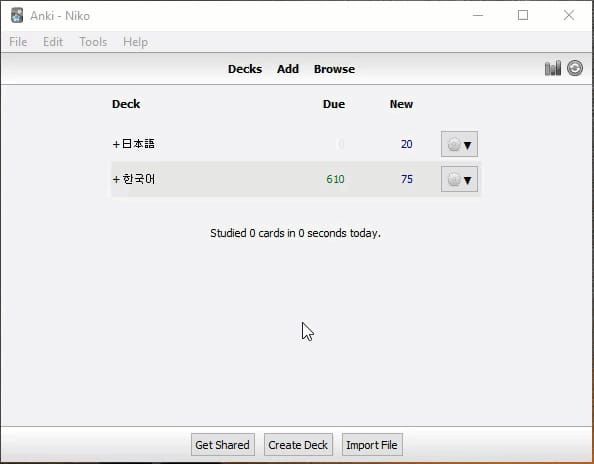
(Note: You may notice that a lot of my Korean flashcards suck. They have vague meanings listed and often lack complete sentences. If I were taking my studies more seriously, I would invest more time, effort, and money to make my flashcards more like the ones we provide students of Japanese.)
Cheating is also a good strategy for avoiding an Anki avalanche. Did you fail to get through all of your flashcards today? Then as you lie in bed, right before going to sleep, just rush through the cards and hit "Good" on every one.
This may stress you out, but you'll find that you forget fewer cards than you might expect when you skip a few Anki reviews. And if you don't remember a card the next time you see it, you can just hit "Again" when that happens. Rei does this a lot, and she is much better at sticking to her flashcards than I am these days.
Option #3: Chip away
Another option is to (1) set your new cards to zero, then (2) limit your daily reviews to a more manageable number.
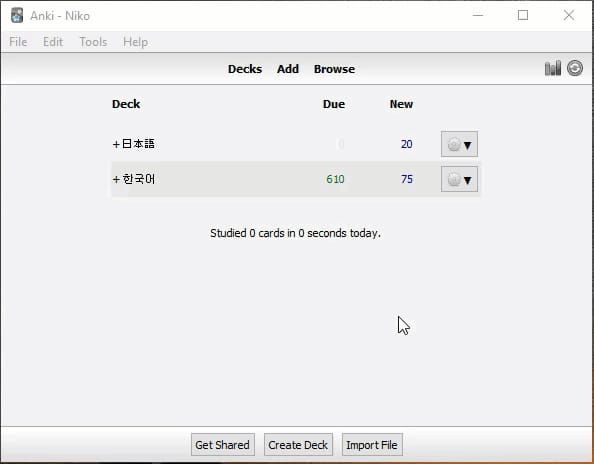
Since there are no new cards being added to your review pile each day, the number of cards due for review will gradually drop. Once it drops to a number you're comfortable with, you can start studying new cards again.
(Note: If you're wondering why the reviews due went to 73 even though I set max reviews to 50, it's because 23 cards were new cards that I started learning but then didn't finish reviewing. Normally this wouldn't happen. And on day #2, there would only be 50 cards to review.)
Option #4: Start over
If you're feeling really overwhelmed, simply resetting the schedule on all of your Anki cards (i.e. making all of them new cards) is another way to deal with an Anki avalanche.
Generally speaking, I do not recommend this method. You probably remember more of these cards than you think, even if you have not studied them for several months.
Still, some people like the idea of starting fresh, so this is an option. There are add-ons that make this easy, too. Here's an example.
If there is one thing to take away from all this, it's the following: Anki avalanches are not the end of the world.
We have strategies for dealing with them. Also, they're just a part of our studies, especially because we'll be using flashcards for several years.
So, if you find yourself facing a seemingly insurmountable mountain of flashcards, don't lose hope! We can get past it.
Niko
