


- The 97-Day Challenge
Walkthrough, Part I
 Niko
Let's make our way through some kanji.
The first character we encounter is ⼀ ︓
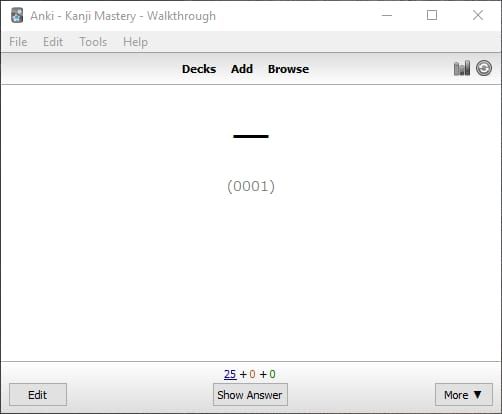
It's our first time seeing this, so we can just hit "Show Answer." If we were reviewing this card, however, we would try to guess what the keyword is for ⼀.
Why do we go "kanji → keyword" and not "keyword → kanji"...?
If you read Heisig's book, you'll see that he recommends the opposite. In other words, he thinks that the front of our flashcards should have the keyword (e.g. "one"), while the back should show the kanji (e.g. "⼀"). That way, we can try to remember the kanji (maybe even draw it) when we see its English meaning.
His main defense for setting things up this way seems to be that you do a better job of learning the kanji itself.
There's just one problem: Being able to recall a kanji in this way is not very useful. 99.9% of the time, we want to be able to recognize kanji. So, it makes more sense to practice recognizing them in our flashcards, which is what we're doing.
There is also a second benefit to doing "kanji → keyword:" It's easier. And we want our flashcards to be as easy as possible so that we can get through them more quickly.
Here is the back of our flashcard:
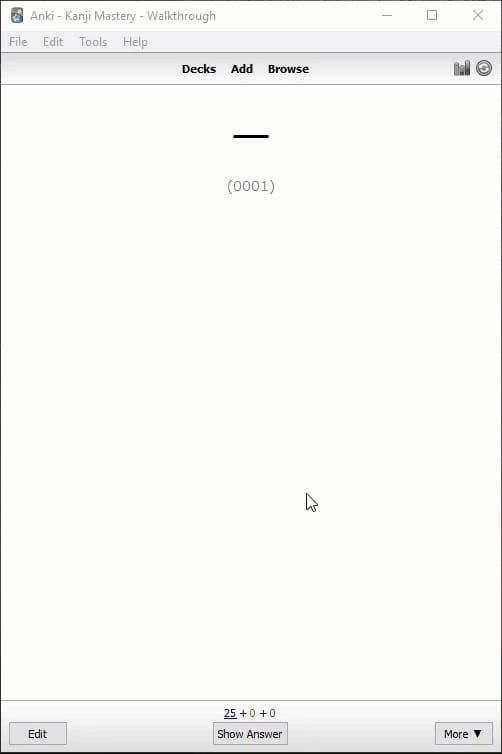
Since the character is so simple, we probably don't need a mnemonic. Or you could follow Heisig's advice and think of ⼀ as the Roman number I turned sideways.
It is important that we check Heisig's comment, though:
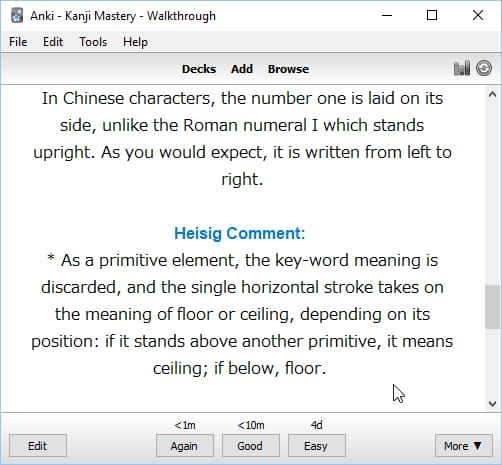
He points out that ⼀, when it appears as a primitive element (i.e. part of another kanji), ⼀ means "floor" or "ceiling," depending on whether it is below or above other primitives.
Once we've finished reading through the info on the back of the card, we can select "Again," "Good," or "Easy," depending on how easy we thought that particular flashcard was. For most new cards, you'll be selecting "Again" right after you learn them. But since you probably "know" ⼀ means "one" after seeing it only once, here you could select "Good" or "Easy." Your decision.
Next we have ⼆, "two:"
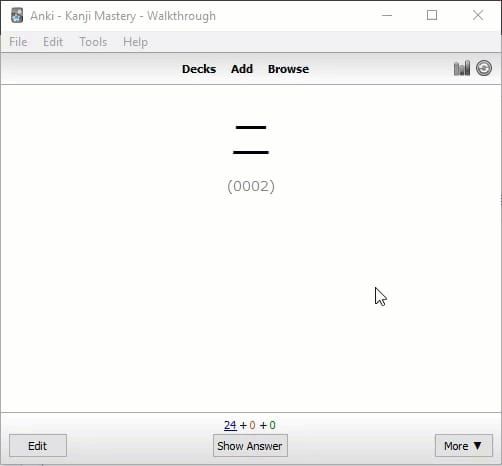
This one's pretty straightforward, so we don't need to spend much time on it. And ⼆ is not a primitive element, so we don't need to worry about that, either.
Note that the top stroke is slightly shorter.
Next kanji!
三 is "three:"
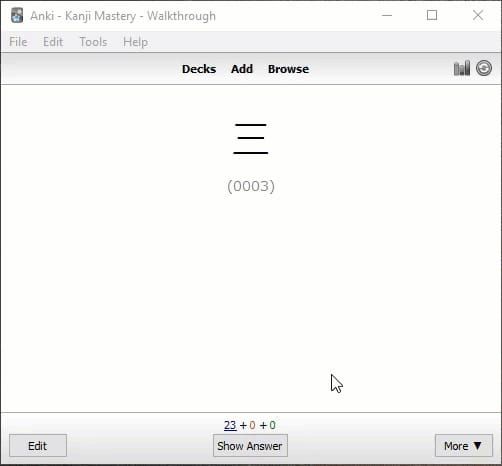
It's worth noting that the middle stroke is shorter. Heisig's mnemonic, and the second Koohii mnemonic both mention this.
Now we're getting into the good stuff.
四 is "four:"
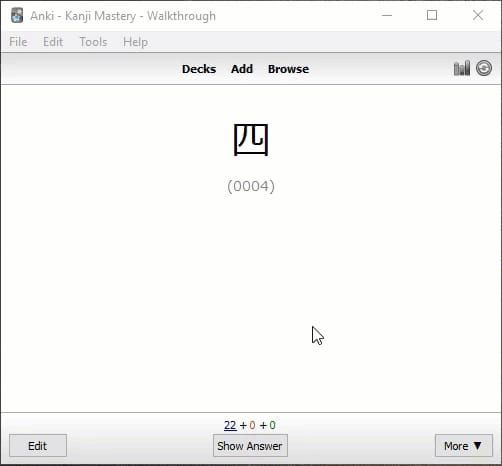
This flashcard is a good example of why we should check all of the different sources of information when learning a new kanji. Every piece of the flashcard is missing information.
Our list of primitives includes "four" (the meaning of the entire kanji, actually), "pent in," and "human legs," but it does not mention an additional primitive, "mouth:"
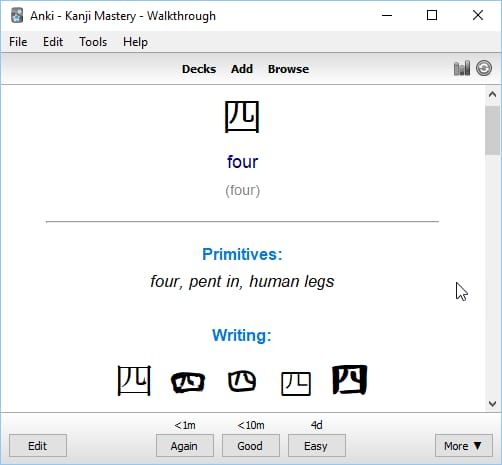
It's not mentioned because "mouth" and "pent in" are the same primitive: ⼝.
We could have attempted to included every possible meaning of each primitive, but it would have made our flashcards a lot more crowded. Additionally, we're better off altering primitives anyway, and it won't be hard to memorize them, so the list of primitives on the back of our flashcards is just a reminder, for the most part.
Anyway, Heisig does mention the meanings of both "mouth" and "human legs," but he doesn't provide a story for the kanji. Instead, he presumes that all of us will already know this kanji:
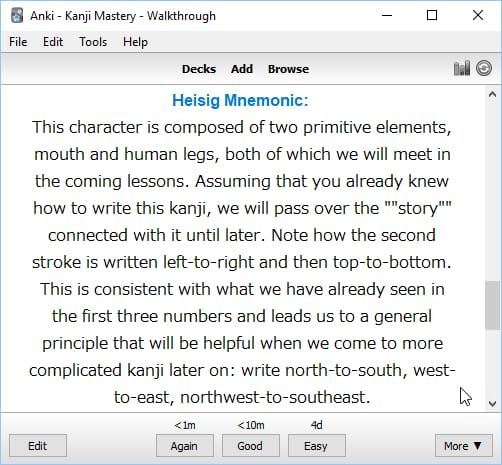
I do not think that we should skip making a mnemonic for this kanji. Luckily, our Koohii homies have provided some:
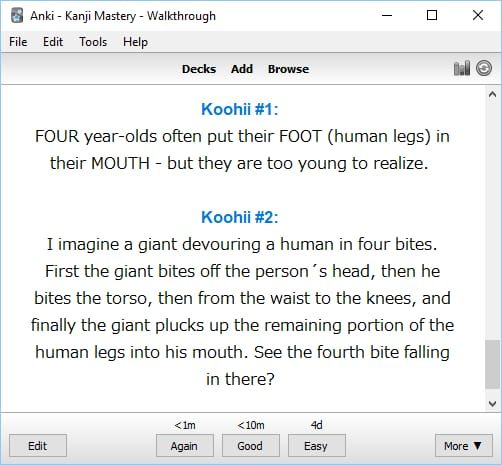
You might like one of these mnemonics and just want to copy it. If you're up to it, however, I recommend going the extra step and creating a better one.
How do we create a better mnemonic for 四?
Well, we (1) use better images for our primitive elements and (2) utilize our spatial memory.
For example, instead of just using the meaning "mouth" for the primitive element around the outside of this kanji, we could pick a specific mouth or mouth-like image that we can use in all of our mnemonics containing ⼝.
I say we use Pac-Man:
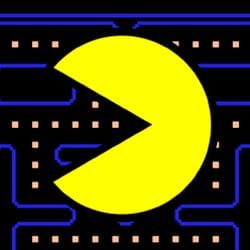
He's pretty well known for his mouth, yeah? And this guy seems a bit more memorable to me than just "mouth" or "pent in:"
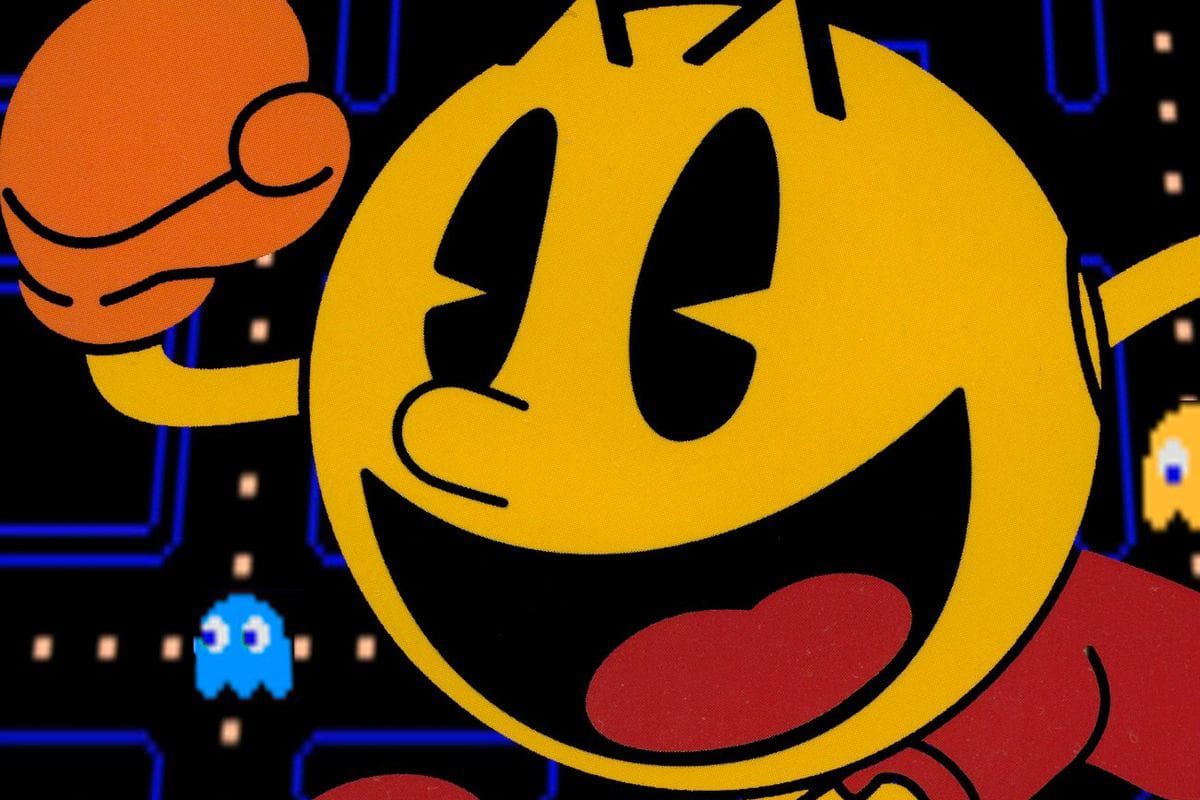
The other primitive is "human legs."
If you find yourself wondering which part of the kanji this is referring to, you can check your primitives PDF:
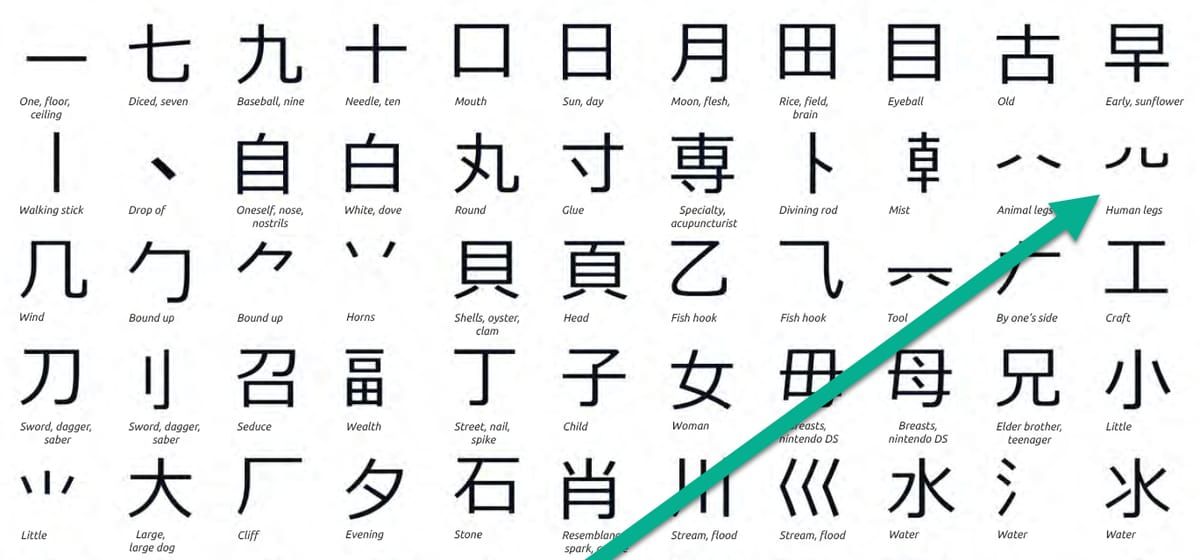
Primitives should be easy to find in the PDF because they are written in the same order in which Heisig uses them in stories. (Since he doesn't use "human legs" in a story until later, it is the 22nd primitive, not the 3rd one.)
"Human legs" isn't a very clear image, is it? I mean, there are a lot of varieties of human
legs. Accordingly, I think we should choose a specific type of human legs that we can use in our mnemonics.
I'm going to go with fishnet-clad, feminine-looking legs:
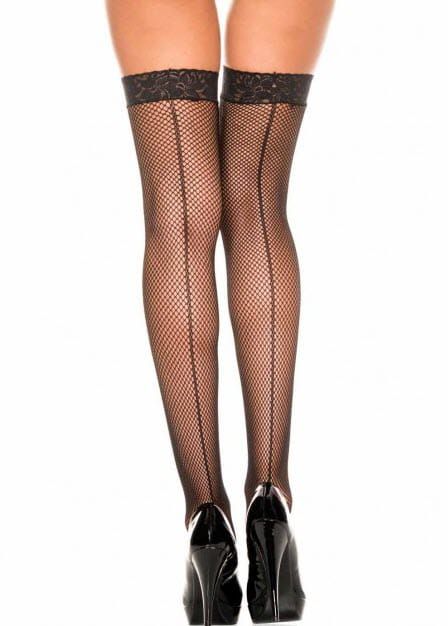
That's a much clearer image.
Now, let's put our mnemonic in the spatial world. For this, you'll want to choose a location that you are intimately familiar with. Just so we can have a little fun, I'll choose one right in the heart of Tokyo.
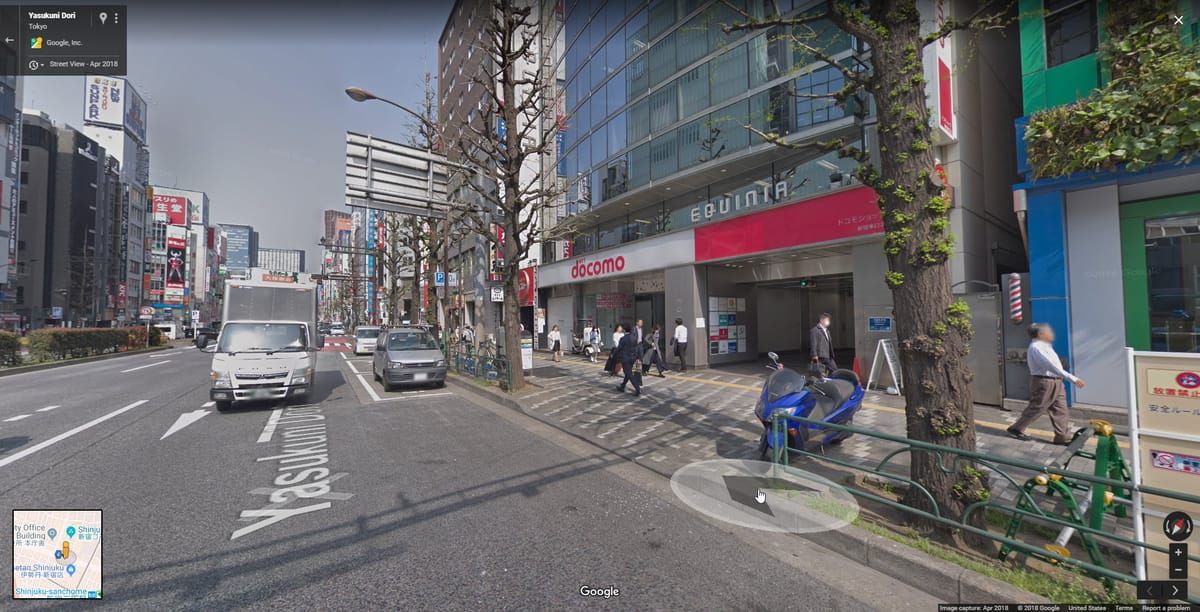
Welcome to the Equinia Building in Shinjuku. I worked on the 6th floor of this building for about two years as an English teacher.
See the entrance?
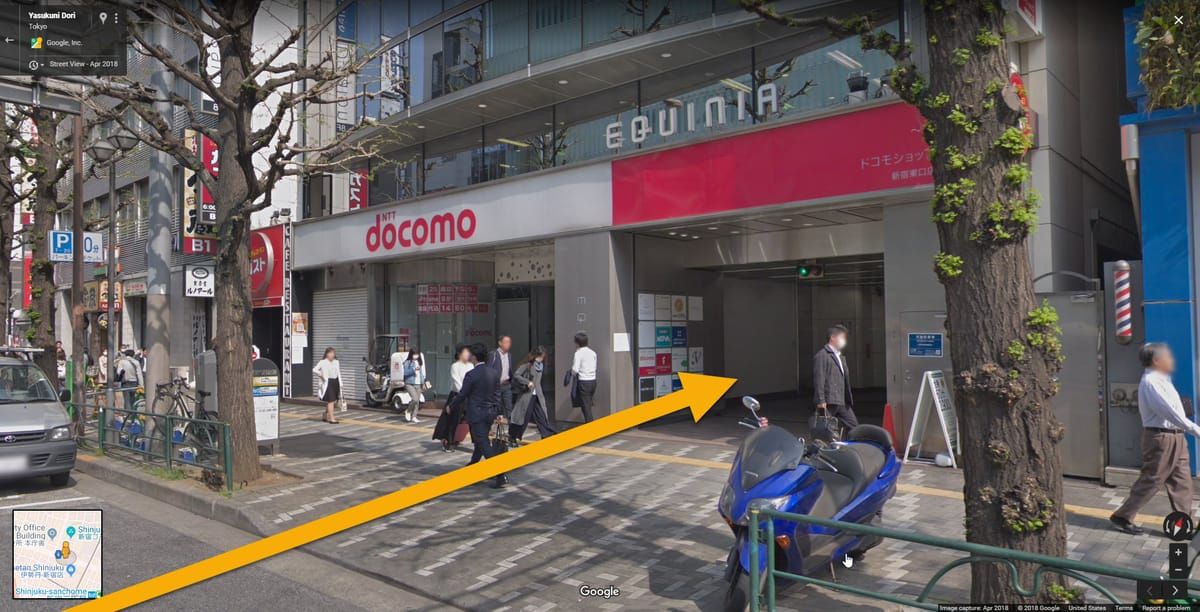
Sometimes Rei used to wait for me there, and I'd be so excited to finish work, to see her waiting for me when the elevator doors opened to the bustling streets of Tokyo. It was awesome.
But what if it's not Rei waiting for me when I walk out of the elevator and into this specific, real-life location with which I am intimately familiar? Instead, maybe it's Pac-Man with four fishnet-clad, feminine-looking legs?!
Now that is an image I am not likely to forget when I see "Pac-Man" (i.e. "mouth," ⼝) and "fishnet-clad, feminine-looking legs (i.e. "human legs") in the kanji 四 (four).
Do we need to write this new mnemonic in our flashcards? Meh. Either way.
If you do want to write all of your mnemonics/stories, you can select "Edit" and then write your mnemonic in the "My Mnemonic" field:
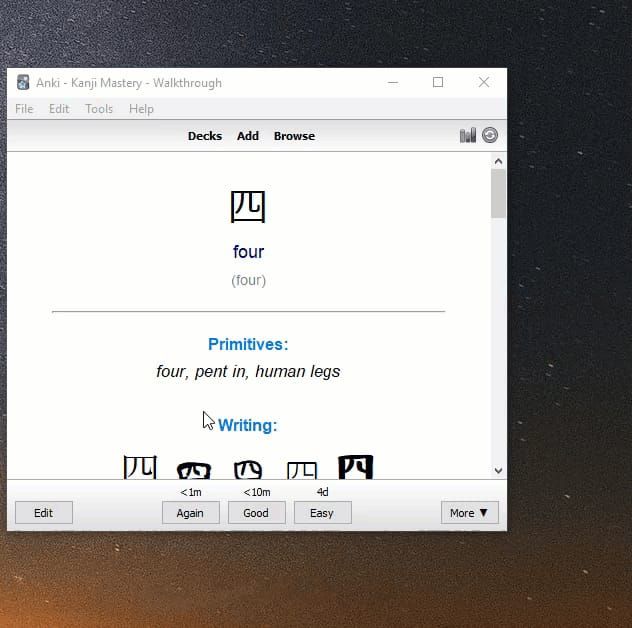
Personally, I think writing our own mnemonics like this is a waste of time. Instead, we can just keep the mnemonic in our head.
But what if we forget it?!?!
Then it wasn't that great of a mnemonic, and we can make a new one. (^_^)/
If you do decide to write your own mnemonics into the flashcards, and you like everything to look neat and beautiful, you may run into a problem.
In the mnemonic above, did you notice that I wrote "FOUR" in all caps? Perhaps you would have liked me to put "four" in bold text and the primitive elements in italics:
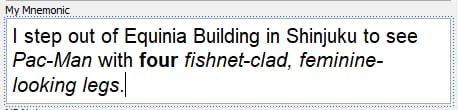
If you write your mnemonic like this, it will not show up correctly in your flashcard:
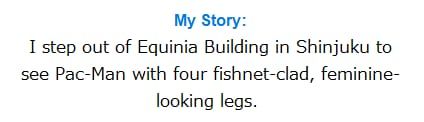
The reason is that these flashcards default to a Japanese font that does not support bold text or italics. To get around this, you have the option of changing the font for your mnemonics to an English-friendly font like "arial." To do this, you would go to "Edit" → "Cards..." and then add a specific font in HTML in the styling section beneath ".mystory", like so:
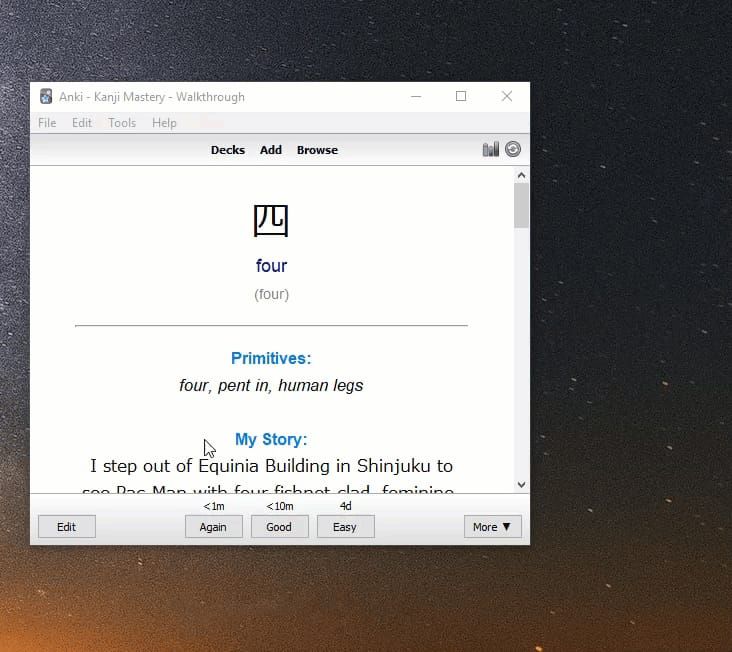
If you're curious, this is what I added to the styling section (without quotations): "font- family:arial;"
Making stories and weird images like this is pretty fun, yeah? ...which means that learning kanji is fun, too.
Are you starting to get a feel for how we're going to make our way through these cards?
I'll take you a little further through the process. Before moving on to the next lecture, however, I recommend reading this one a few times.
Niko
