


- The 97-Day Challenge
Your Kanji Flashcard Deck
 Niko
First, here is the Anki deck that you will use to study the kanji:
HJS Premium Master Deck. HJS Basic Master Deck.
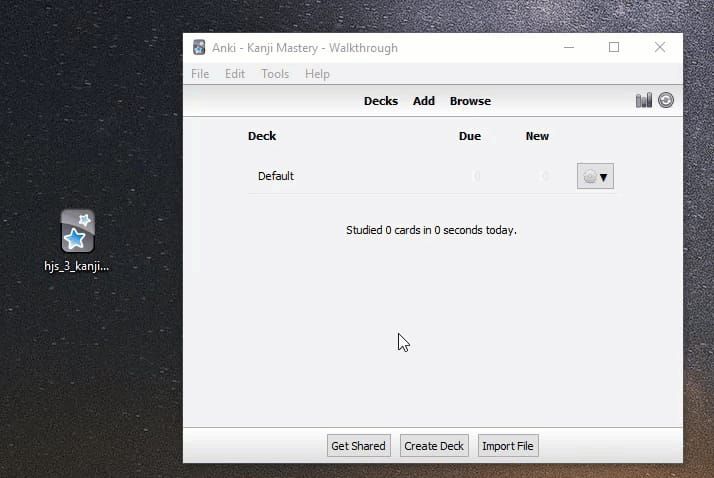
Once we've downloaded the Anki deck, we need to open Anki.
After we have opened Anki, we can just double-click the Kanji Mastery deck to import it:
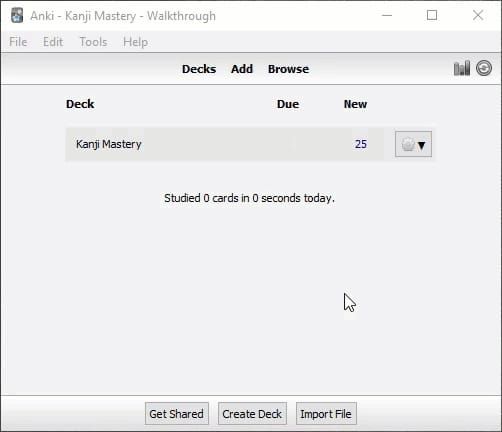
See the number 25 under where it says "New?" That is the number of new kanji that Anki wants you to learn per day.
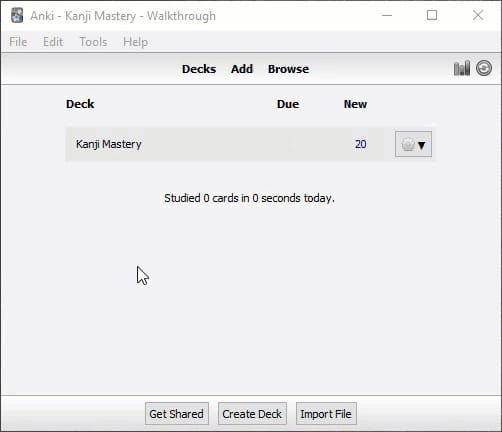
It is possible to change this. For example, here we are changing it to 20:
You'll also notice that the maximum number of reviews is set to 9999 per day. This is because we want to be sure that Anki shows us every card that we need to review each day. Some people choose to change this to a number other than 9999, but I don't recommend it.
Let's see what happens when we open the Anki deck and start studying:
As you can see, there is A LOT of information in these flashcards. Here is a breakdown of everything we see in a card:
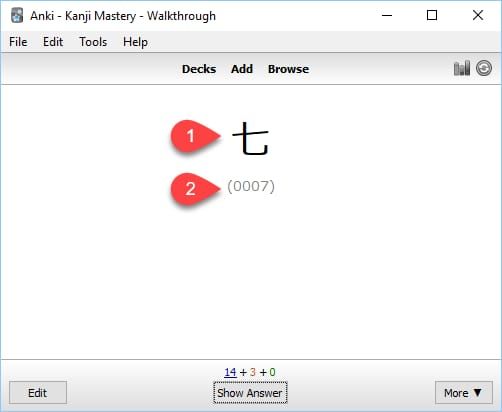
↑ On the front of the card, we have (1) the target kanji, along with (2) the Heisig number of the kanji. If you have Heisig's Remembering the Kanji (and I really hope you do, if you're
using this method), then this makes it easier to look up the character in your book. It is also an easy way for us to track how far we've come in our kanji studies.
↓ On the back of the card, we have...
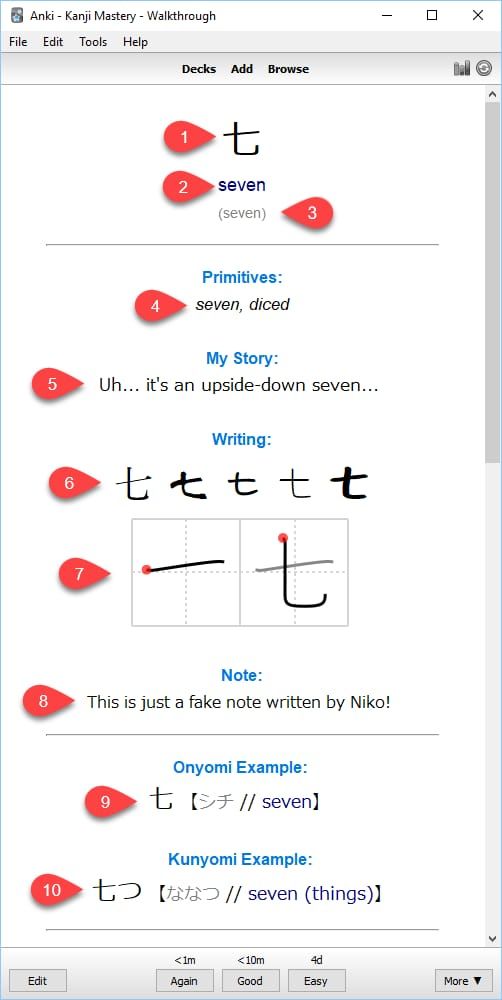
(1) The kanji itself.
(2) The one-word meaning (i.e. keyword) that we'll use to remember the kanji.
(3) Other possible meanings of the kanji. (In this case, it's just the one meaning.)
(4) The kanji's constituents/primitives. (Note that this includes both the parts that make up the kanji and the primitives that this kanji will act as in future stories. More info on this later.)
(5) The mnemonic that you create to remember this kanji. (If you're like me, and you just keep it in your head, then this part will not show up on your cards.)
(6) The target kanji written in various fonts.
(7) The stroke order of the kanji.
(8) A note for further clarification about the kanji or it's meanings, keyword, etc.
(9) An example of the onyomi reading of the kanji. (If nothing shows here, it is because there are no common/useful words containing that reading. The same goes for...)
(10) An example of the kunyomi reading of the kanji.
Additionally, we have...
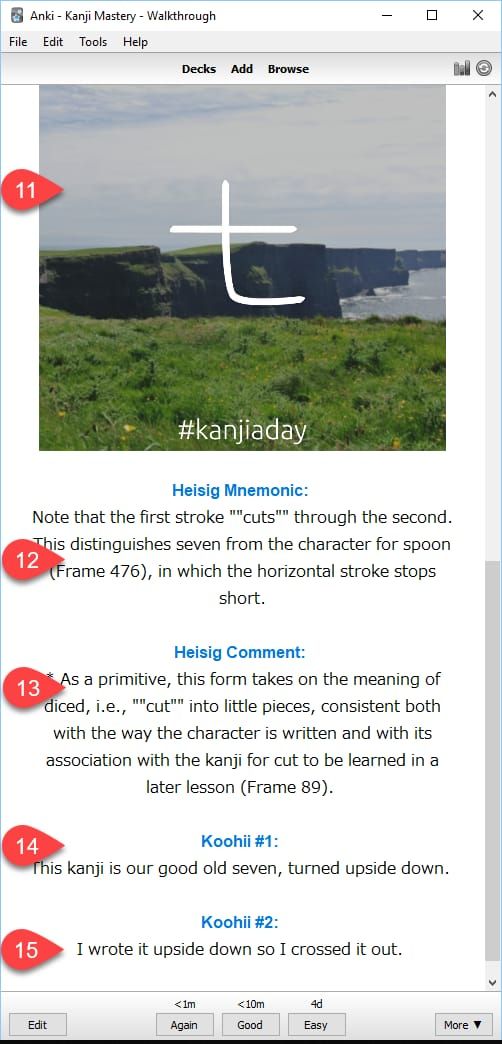
(11) An image that can help in memorizing the kanji. (These are taken from our #kanjiaday Instagram project.)
(12) | The mnemonic/story that Heisig provides for this kanji, if any. |
(13) | A note or comment that Heisig provides for this kanji, if any. |
(14) | The most popular mnemonic/story for this kanji on Koohii. |
(15) | The second most popular mnemonic/story for this kanji on Koohii. |
If you're feeling a bit panicked, it may help to know that you do not have to read through every single bit of this information every time you review a kanji. Most of this is to assist
with when you first encounter a new kanji card, or when you have forgotten the meaning of a kanji that you are reviewing.
When reviewing, usually you won't read anything but (1) the kanji and (2) the one-word meaning (i.e. keyword).
Speaking of learning kanji, I'll walk you through some of them...
Niko
