


- The 97-Day Challenge
Walkthrough, Part IV
 Niko
冒 is "risk:"
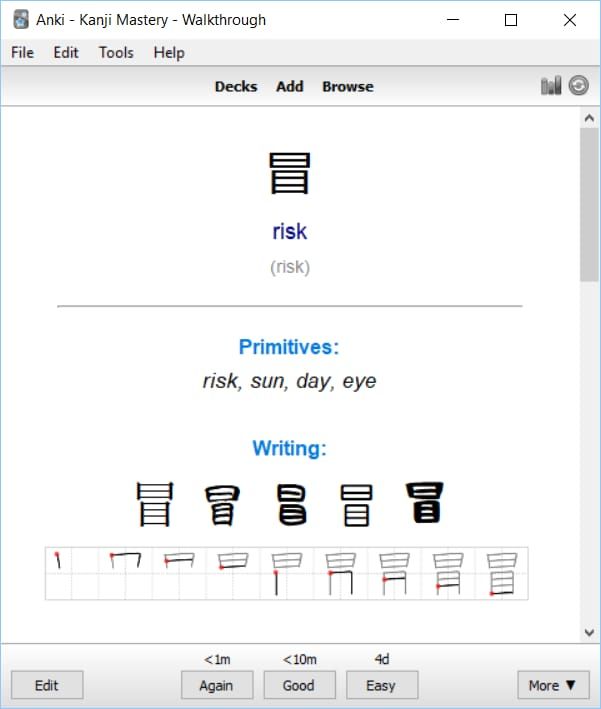
Sometimes the primitives that make up a kanji are just perfect for a little mnemonic phrase — so perfect that we don't really need to worry about vivid images, spatial memory, etc.
I would argue that this is on such case: Don't look at the sun (⽇) with your eyes (⽬); it's risk y (冒).
朋 is "companion:"
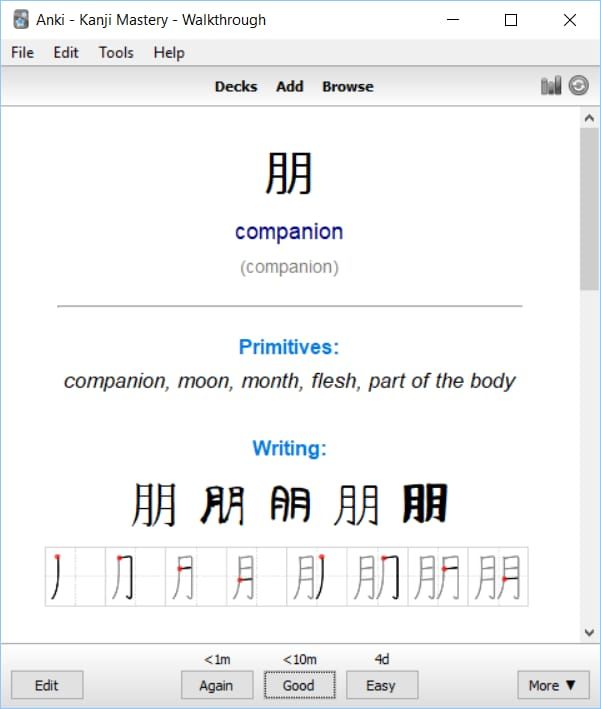
As the note points out, this isn't a very useful kanji:
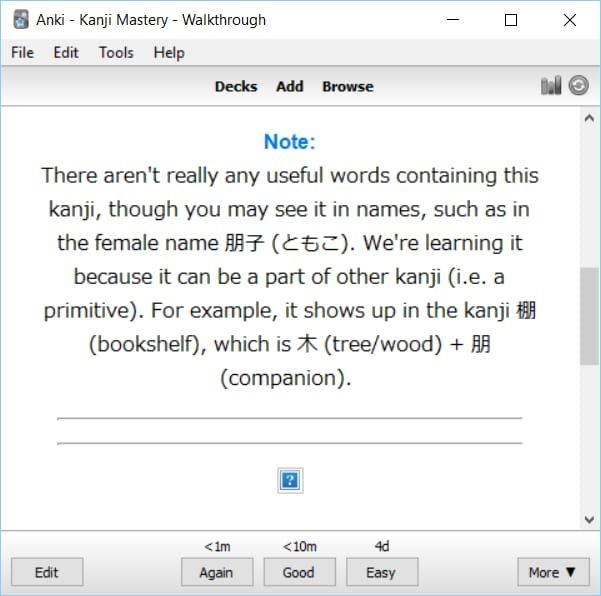
...which is why there are no example words to go with it.
Still, we can throw it in to our memory palace....
After passing the pack of ten elderly Pac-Mans going into ガスト, I see Sailor Moon (⽉) going into Cafe Renoir (ルノアール) with a clone of herself (a second ⽉), her only companion (朋) in the world. (Maybe the other Sailor girls died or something...)
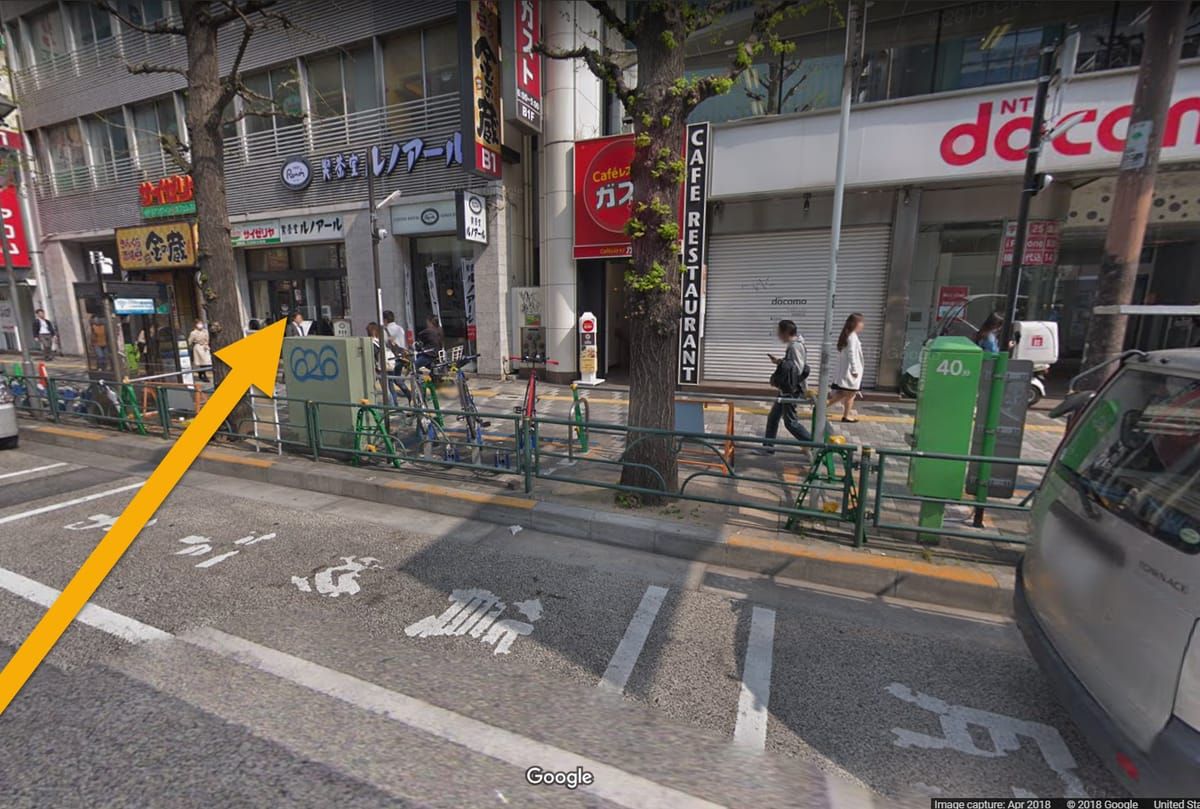
Cafe Renoir is an upscale cafe, which seems appropriate for Sailor Moon and her cloned companion. I went in there for coffee a couple of times during my break at work, so I have a distinct memory of the place.
If you don't like the above mnemonic, using one like Heisig's is an option, too:
The first companion that God made, as the Bible story goes, was Eve. Upon seeing her, Adam exclaimed, "Flesh of my flesh!" And that is precisely what this character says in so many strokes.
...Heisig uses biblical references in an oddly large percentage of his kanji stories.
We're up to our 20th kanji now: 明, "bright:"
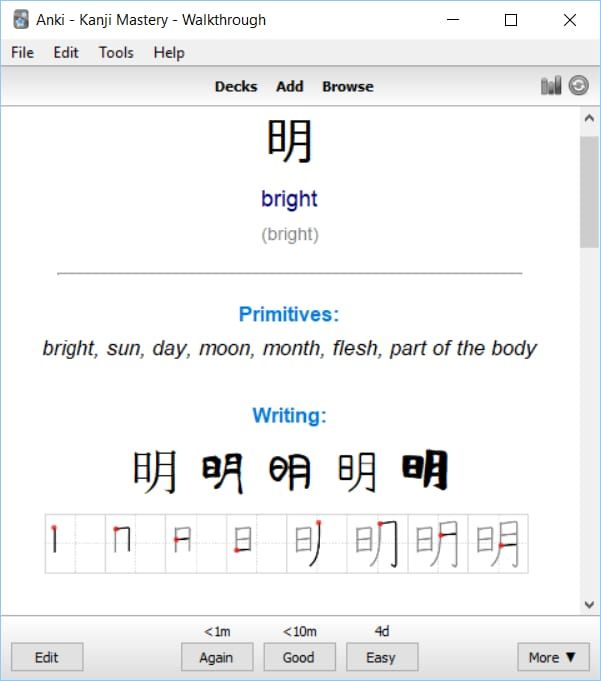
There are a lot of directions we could go with our mnemonic here. Maybe Sailor Moon harnesses the power of the sun and shines brightly. Maybe Sailor Moon stands in front of me for an entire day while gathering her power, until she shines as bright as the sun.
Or we could go with something like this...
After the two Sailor Moons (朋) stepped into Cafe Renoir (←previous mnemonic), there was a bright flash of light, then out stepped... not Sailor Moon (⽉), but Sailor Sun (⽇), blindingly bright (明) light emanating off of her.
Remaining Flexible: If I find that Sailor Sun acts as a memorable primitive for (⽇),
then I can start using that in future mnemonics. I could even start altering the characters Sailor Moon (⽉) and Sailor Sun (⽇) so that they are distinct. Maybe Sailor Moon is a force of evil, while Sailor Sun is a force of good... although I'm guessing that would only work if, like me, you have little memory of the stories about Sailor Moon.
My point is: Nothing is set in stone, and we do not have to plan out everything in advance. We'll find the best primitive meanings as we try to think of new mnemonics for new kanji we encounter.
The keyword for 唱 is "chant:"
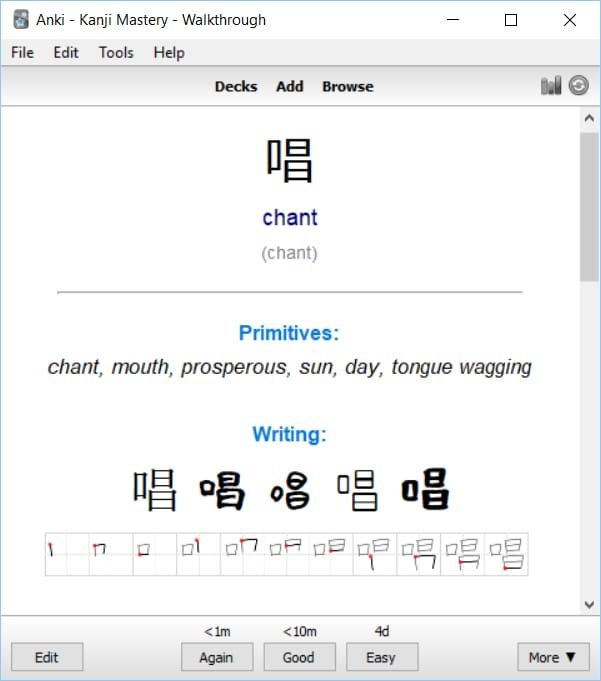
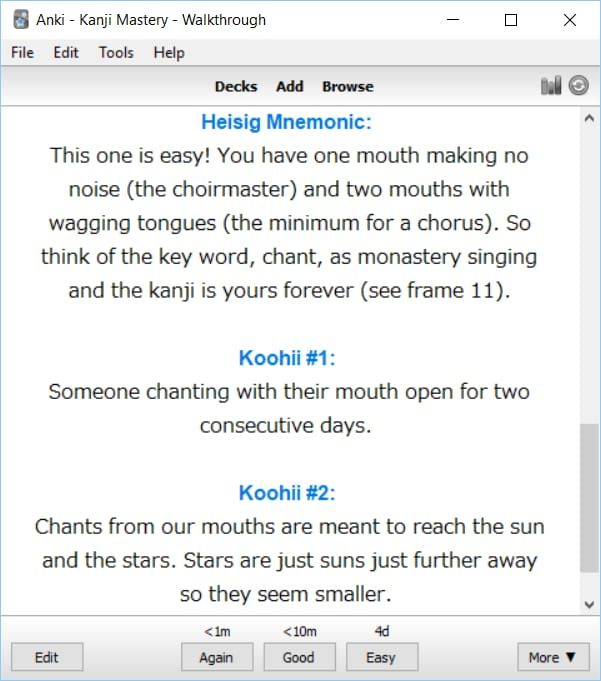
Heisig likes to use his "tongue wagging in the mouth" primitive for this one:
If we want to use our spatial memory and whatnot (pretty much the only way I remember anything), we can say something like:
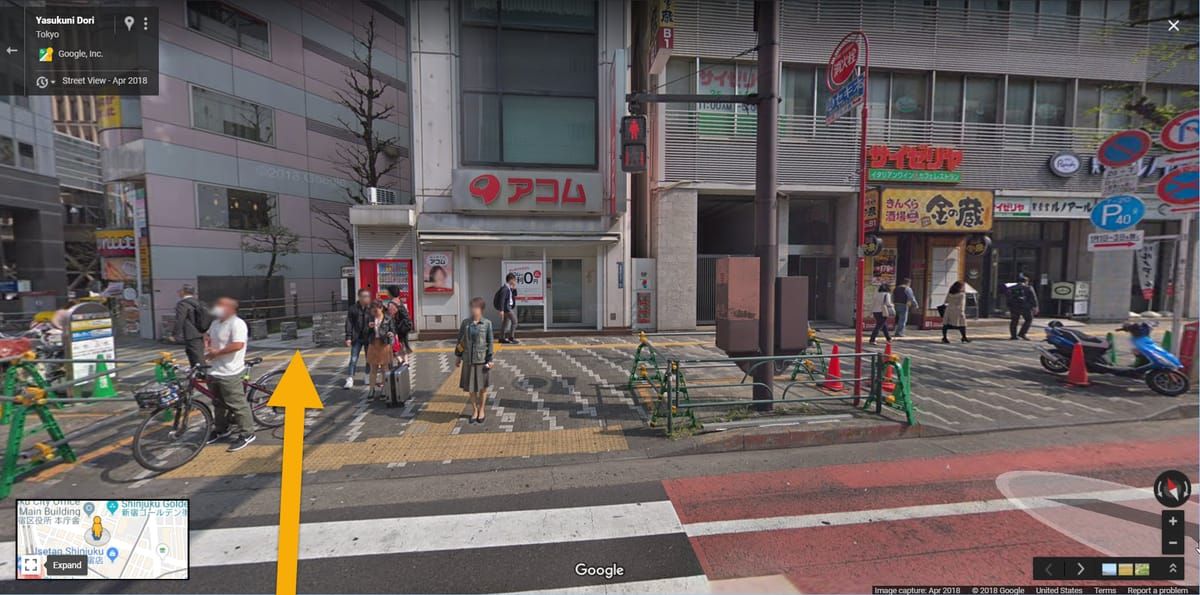
Right as I was about to pass the path toward Golden Gai, Pac-Man (⼝) stopped me and made listen to him chant (唱) for two days (⽇ + ⽇) straight (all weekend).
Alternatively, Pac-Man (⼝) and two Sailor Suns (⽇⽇) made me listen to them chant (唱). Apparently they're part of a new cult or something.
晶 is "sparkle:"
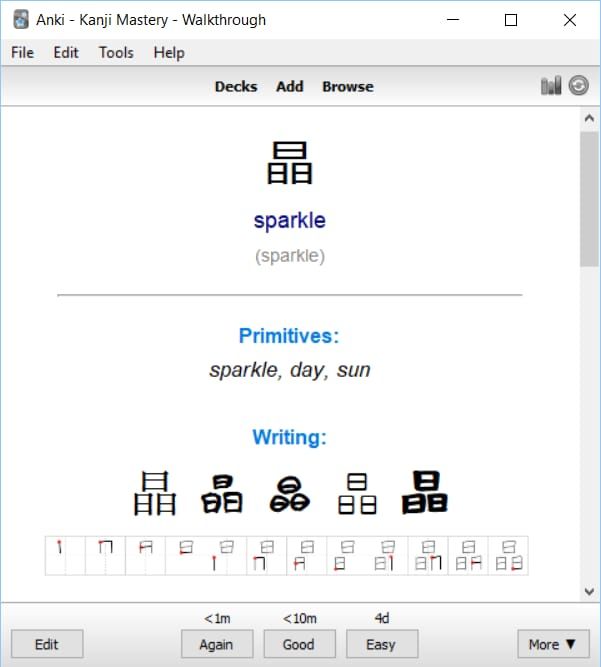
So many options!
We could play around with how much three Sailor Suns (⽇⽇⽇) would sparkle (晶).
Or we could work off of the mnemonics provided by others and think about how diamonds sparkle (晶) as much as three suns (⽇⽇⽇).
Or we could ditch the images and say: The world started to sparkle (晶) when it was announced that everyone would have three-day (⽇⽇⽇) weekends from now on.
Or we could use space to dictate the direction of our story:
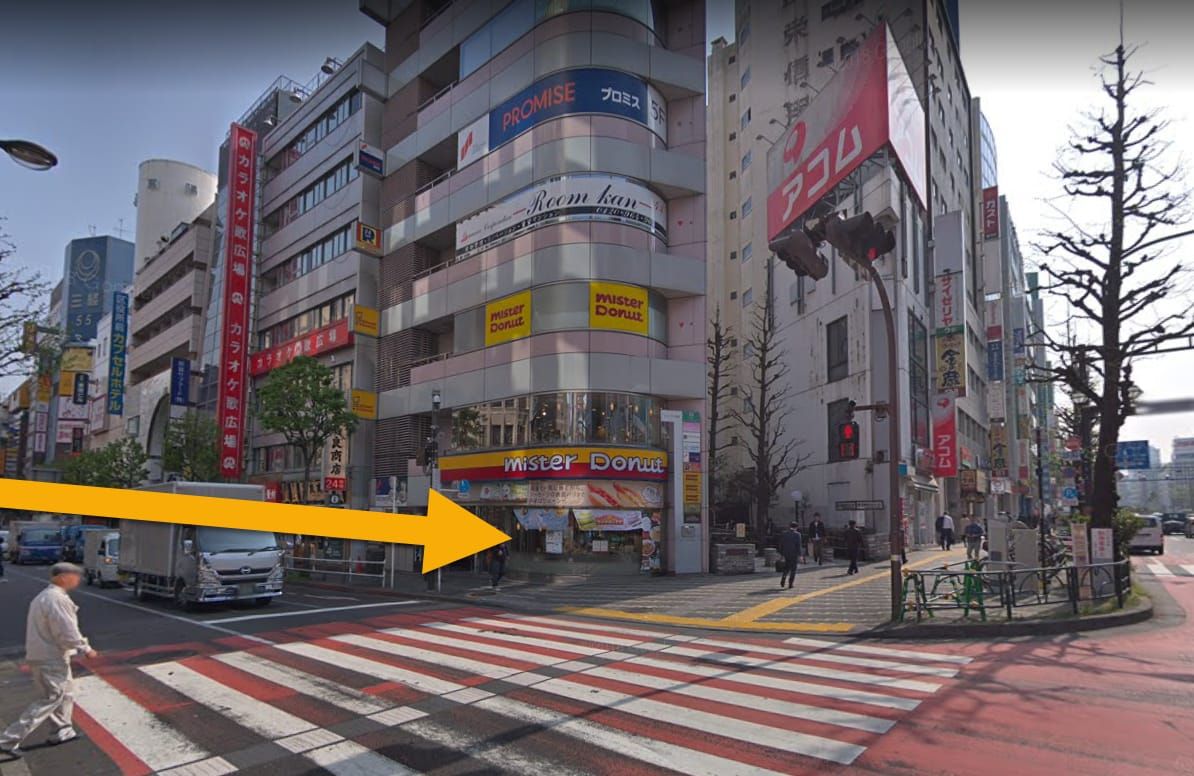
There was a 3-day (⽇⽇⽇) line just to try Mister Donut's new sparkle (晶) donut. (Maybe eating it will make you sparkle or something.)
品 is "goods" (i.e. products, merchandise):
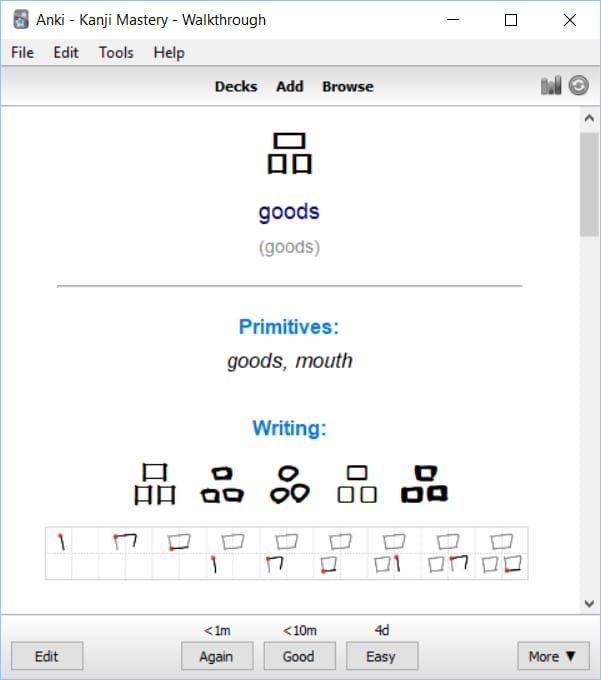
Agh, it's hard for me to keep thinking of good mnemonics for these kanji with repeated primitives. Luckily, this happens less often once we get a larger library of primitives in our brain.
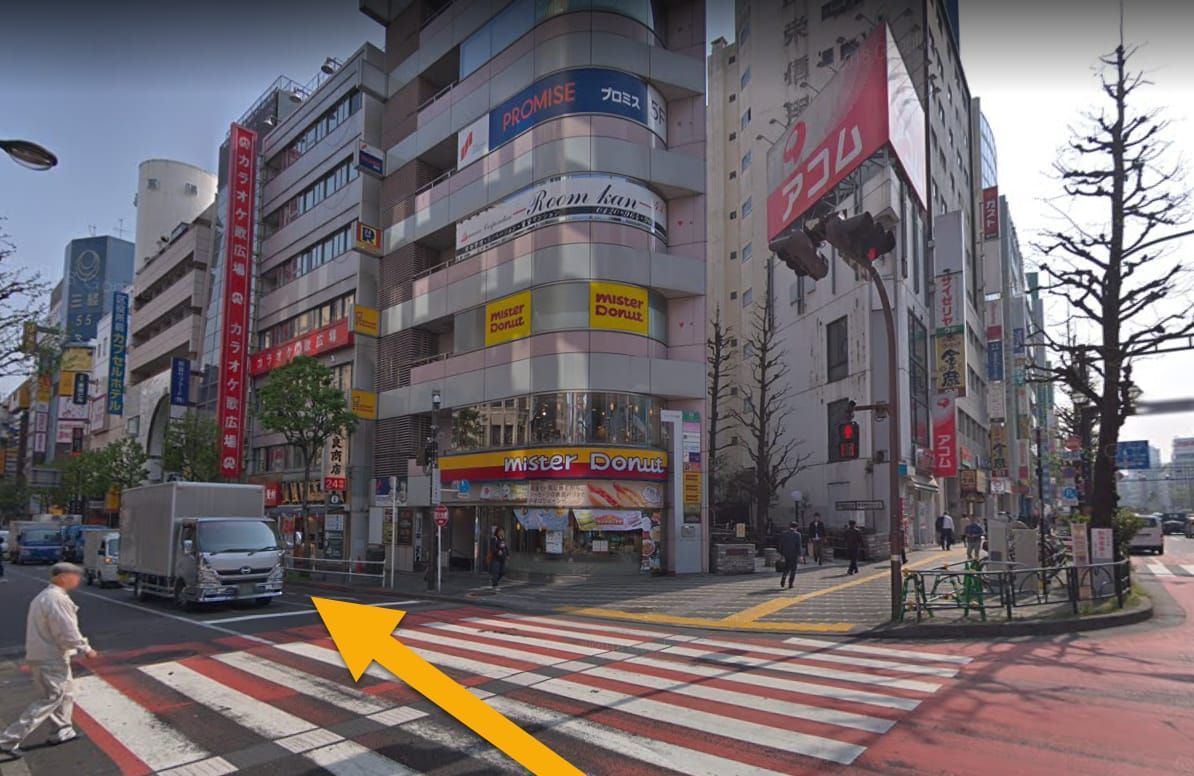
A bunch of goods (品) fell out of a truck that was driving past Mister Donut. Within mere moments, they were devoured by three ravenous Pac-Mans (⼝⼝⼝).
Or we could just picture that this is a stack of three boxes — goods (品) to be sold.
About Word Choice: Did you notice that I used the words "devoured" and "ravenous" instead of "eaten" and "hungry" in the mnemonic above?
The reason is that I am trying to avoid using words that will be keywords for future kanji we learn. A quick look at the index of Heisig's Remembering the Kanji reveals that both "eat" and "hungry" are keywords for kanji that we'll learn later. So, we can use words that won't be keywords, like "devour" and "ravenous," instead.
It's not always possible to do this. And it's not that big of a deal if you occasionally let a keyword or primitive word slip into a mnemonic even when it has nothing to do with the kanji. Your brain will be able to deal with it, I promise you. And you can always go back and alter mnemonics if things start getting mixed up.
呂 is "spine:"
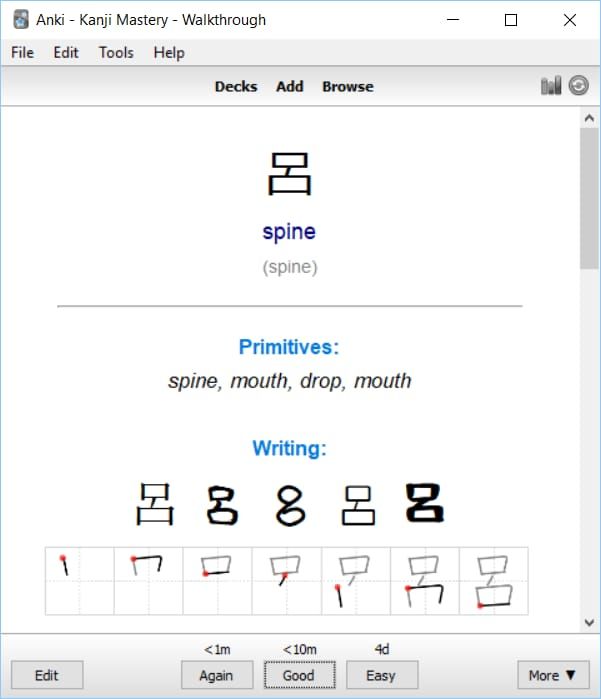
I say go with the pictograph here: It looks like two of the vertebrae in the spine linked by a single stroke.
I can't help but mention that the meaning of "spine" will only be useful when building mnemonics for other kanji:
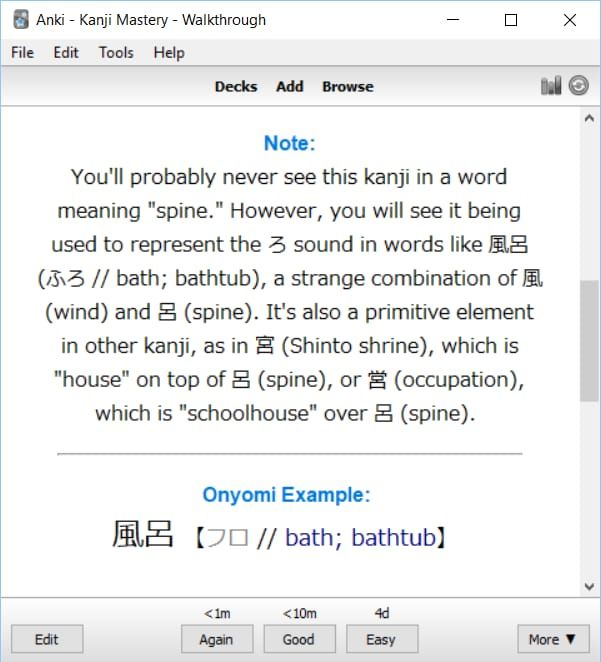
昌 is "prosperity:"
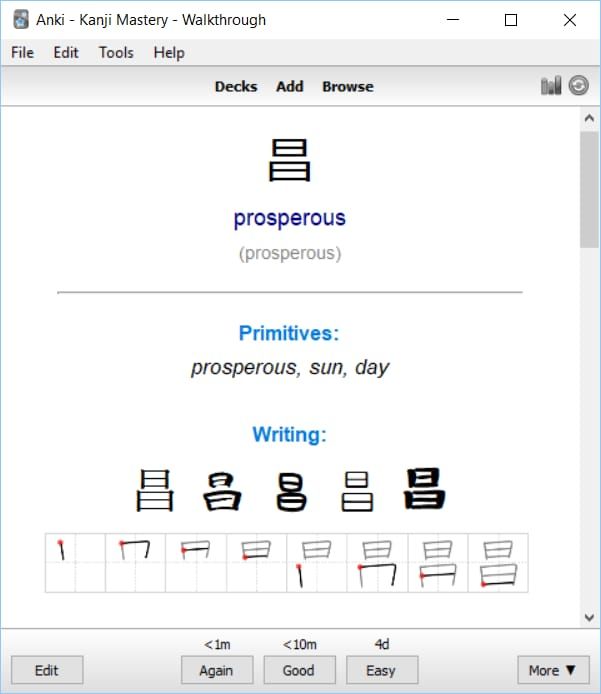
I think the Koohii #1 meaning is great here, so I would leave it out of my memory palace: "If you work from Sun UP to Sun DOWN, you will be prosperous (昌)."
...or you could try to make up something about two Sailor Suns, two suns — whatever — and put it into your memory palace.
That's 25 kanji finished! We're making progress...
Niko
